Mary River facing hurdles on both sides of Baffin Bay

iAbout Press releases
As part of our continuing efforts to bring you as much information about our region as possible we offer readers a press release service that allows private firms, public agencies, non-governmental organisations and other groups to submit relevant press releases on our website.
All press releases in this section are published in their full length and have not been edited.
If you have a press release or other announcement you would like to have published, please send it to [email protected].
We reserve the right to reject press releases we deem irrelevant or inappropriate.
All material submitted to The Arctic Journal, including pictures and videos, will be assumed to be available for publication by The Arctic Journal and its related entities.
Baffinland, a Canadian mining outfit, has something of a gold mine on its hands.
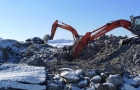
Since September 8, the Toronto-based firm has been producing iron ore at its Mary River facility, at the northern tip of Baffin Island. Currently, Baffinland is approved to produce about 4 million tonnes annually. It says it can easily triple its production. There is little doubt it can: Mary River sits atop one of the world’s largest iron ore deposits and may well be able to produce as much as 30 billion tonnes a year for 20 years.
Tougher, though, will be getting the ore to market.
When the mine was proposed, Baffinland had suggested shipping the ore from a port facility on a south-facing coast. Plans were drawn up for improved port facilities, a railway and other infrastructure that would allow it to sail the ore through Foxe Basin, a body of water north of Hudson Bay.
SEE RELATED: Here today, ore tomorrow
After the investments that would have paid for all that failed to materialise, the firm changed course: in the first phase of the mine’s operations, it would ship ore from a north-facing coast.
However, in order to transport ore 10 months out of the year, as Baffinland would like, it would need to break ice in Mine Inlet, a waterway that leads to Baffin Bay. And it is there where the firm has run into resistance from Nunavut’s approval authorities.
In an April 8 decision, the Nunavut Planning Commission, which is responsible for ensuring that the mine’s plans are in line with land-use regulations, nixed the plan.
The commission grounded its decision, which was the first time in the body’s 15-year history it has voted against a plan, on the fact that Milne Inlet, which serves as both a hunting area and a transport route, was an “essential area” for surrounding communities, and that ice-breaking would disrupt those uses.
SEE RELATED: Editor’s Briefing | Another one bites the ore
Without ice-breaking, Baffinland can only ship ore through Milne Inlet from June to October, which the NPC estimates would be enough time for it to ship about eight million tonnes a year.
The ice-breaking plan put the NPC in something of a bind. It is aware of the importance of Mary River for the region’s development, say officials in government and industry. However, as it made clear in its decision, the panel is charged with ensuring that projects are in line with land-use plans, which, it reminded Baffinland, had been created to promote the well-being of residents. In the end, it concluded that while the iron mine was important for the economy, ice was an essential part of life in the North.
“For people, polar bears, for seals and other animals in the North, ice is a bridge – both metaphorically to the past and present Inuit values and activities, and also actually as a fact.”
Although the NPC’s position would seem to rule out ice-breaking as an option, the decision offered Baffinland four options, ranging from scuppering its ice-breaking plans entirely to appealing the decision to the federal government in the hopes that it will find differently.
SEE RELATED: To be transparent or not to be transparent, that is NOT the question
Whether it will go that far is uncertain. Baffinland has yet to consider its response, but Greg Missal, the vice-president of corporate affairs, underscored that the company will work with the NPC to come up with an option that takes traditional use into account.
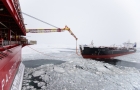
Baffinland’s transport hurdles are not limited to Nunavut, however. On the other side of Baffin Bay, in Greenland, several groups have expressed concern about a proposal that would see the company transfer loads of ore from smaller vessels capable of sailing in Milne Inlet to larger, ocean-going vessels that will transport it to Europe.
The procedure needs to take place in calm waters. Canadian territorial waters cannot provide a suitable location, but Baffinland has identified three sites along the Greenlandic coast that it says provide both an adequate location and give it access to necessary on-shore services such as airports, hotels, refuelling facilities and the like.
Like with other natural resource projects, before Greenland’s Self-Rule Authority decides whether to approve the plan, it will consider it environmental impact and what the benefit to the country will be.
That should not be difficult. The environmental risks associated with the process are considered minimal, limited mostly to the possibility of an oil spill during vessel refuelling. And Baffinland officials, who have been in Nuuk twice to pitch the idea, are keen to underscore the economic benefits the ship traffic will have for Greenlandic firms.
Among locals, few are dead-set against the idea. But, as in Milne Inlet, residents near the proposed sites wonder how it will affect their lifestyle. Trans-shipping is a noisy, dusty process that would take place over two days 35 times a year, and fishermen and hunters say one of the sites on the short-list is an important breeding and catch area for all manner of species ranging from salmon to humpback whale. They fear their livelihood will be affected.
Pleasure boaters have not mounted the same organised level of protest, but that does not mean Baffinland is unaware of their potential to rock the boat. It has all but given up on pursuing its top choice, a location 20 nautical miles from Nuuk, due to its popularity with residents in the capital city.
Seeking approval to trans-ship there, the firm has conceded, would be a hurdle too far.