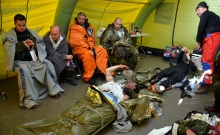
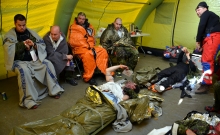
Mercury-pollution fears spark flood of protests
iAbout Press releases
As part of our continuing efforts to bring you as much information about our region as possible we offer readers a press release service that allows private firms, public agencies, non-governmental organisations and other groups to submit relevant press releases on our website.
All press releases in this section are published in their full length and have not been edited.
If you have a press release or other announcement you would like to have published, please send it to [email protected].
We reserve the right to reject press releases we deem irrelevant or inappropriate.
All material submitted to The Arctic Journal, including pictures and videos, will be assumed to be available for publication by The Arctic Journal and its related entities.
Editor’s Briefing is a regular summary of the main points about a current topic. At the end of each summary we provide a list of external articles and resources to give readers a place to begin if they would like to learn more.
Other internet bits and bobs, including Tweets and videos, are occasionally included.
As a way to encourage discussion about the topic, the briefing will also seek to include opinionated commentary. If you would like to suggest a topic for a briefing, or if you would like to provide a comment about a topic, please contact us.
Cautious optimism from this protester at the #MuskratFalls site as Dwight Ball meets with Aboriginal leaders in St. John's #nlpoli pic.twitter.com/HvejxcuLE7
— CBC Newfoundland (@CBCNL) October 25, 2016
22 protesters + any other persons unlawfully occupying project site ordered to appear in court no later than Nov. 10th #cbcnl #muskratfalls pic.twitter.com/4zbX8x09iZ
— Jacob Barker (@JacobBarkerCBC) October 25, 2016
4 request from the 3 #MuskratFalls hunger strikers. If requests fulfilled they will complete their hunger strike #makemuskratright pic.twitter.com/U7oFDRmDOe
— Ossie Michelin (@Osmich) October 25, 2016
For the 2,000 Inuit living near Lake Melville, in Nunatsiavut, Labrador, the choice has come down to taking risk into their own hands or letting Nalcor Energy, a provincial energy corporation, take a risk for them.
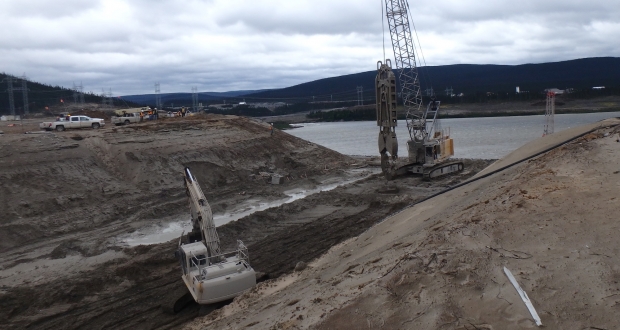
The risk (to use Naclor Energy’s own term) they are willing to take is putting themselves in physical danger by occupying the construction site of an C$11.4 billion ($8.54 billion), 824 megawatt hydroelectric dam at Muskrat Falls, on the lower part of the Churchill River.
The dam is downstream of Lake Melville, and, the protestors say, presents a risk they are not willing to let their community take: increasing the amount of mercury pollution in the lake, the primary source of food for many of the area’s residents, by between 20% and 200%, according to a 2015 Harvard University study.
SEE RELATED: The Canadacast | Uranium in Nunavut: unsustainable energy?
Occupation of the site began on Sunday, when a group of about 50 people broke through a gate in the surrounding fence. The group had been taking part in months-long protests gathered outside the construction site.
Those protests had already resulted in a Labrador court issuing a temporary injunction on October 16, ordering those taking part to disperse on the grounds that they were delaying work. The crowds did not leave, and, after Sunday’s incident, the court has now toughened its language. In a new injunction it names 22 people known to be inside company buildings, including a journalist covering the protests,
The injunction authorises law-enforcement officials to arrest and detain the individuals, or “any other persons found unlawfully occupying the project site”, until they can be taken before a judge on charges of violating a court order. Those involved, encouraged, in part, by what they said was the support of workers, have responded by saying they have no intention of leaving the site until their concerns were addressed.
At the same time, a group of three individuals staging a hunger strike say they are prepared to continue until their list of demands (see tweet at right) are met.
SEE RELATED: Not now. But soon?
For its part, Nalcor admits that mercury levels (in the form of a substance known as methylmercury) will temporarily increase once the river is dammed, and that residents will be instructed to limit their consumption of animals caught upstream from the dam, including fish, seal and other animals Inuit eat, for a period of 15 years or so.
Likewise, the protestors are not disputing construction of the dam itself. In June, Perry Timper, Labrador’s environment minister, proposed paying financial compensation to residents to allow them to purchase food. Although Nunatsiavut officials have not turned down the offer, what residents want most is for steps to be taken that will limit the amount of mercury that builds up in the dammed-up waters. This, everyone agrees, can be done by removing topsoil and trees from the area to be flooded.
Mr Timper had initially ruled out any possibility of trees being removed. Nalcor Energy, on the other hand, appears to be in more of a mood to compromise: after first agreeing to cut down some trees, it now says it will expand that number. It still refuses to meet Inuit demands to remove the soil from the 11sq km area where flooding is expected to begin later this year, however. It argues that doing so would be “unprecedented” in connection with construction of a hydroelectric dam.
Were they to see the dam for the soil for a change, it would be equally unprecedented.
FURTHER READING
- Newfoundland and Labrador premier to meet with aboriginal leaders over Muskrat Falls
Toronto Star/The Canadian Press - Court order threatens Muskrat Falls protesters with arrest
CBC Newfoundland & Labrador - Protesters occupying Muskrat Falls site putting themselves at risk: Nalcor
Global News/The Canadian Press - Journalist facing possible arrest for Muskrat Falls coverage says story is of ‘utmost importance’
Aboriginal Peoples Television Network - Innu Nation wants flooding suspended as Muskrat Falls protest grows
The Independent - Halt Muskrat Falls until contamination concerns addressed, says Nunatsiavut government
CBC Newfoundland & Labrador - Nunatsiavut 'cannot be bought' with Muskrat Falls mercury compensation plan
CBC Newfoundland & Labrador - Poison in Arctic and human cost of ‘clean’ energy
Harvard Gazette
SOURCES
- Project Overview
Nalcor Energy - Freshwater discharges drive high levels of methylmercury in Arctic marine biota
Proceedings of the National Academy of Sciences
Latest news