
Melting above their weight
iAbout Press releases
As part of our continuing efforts to bring you as much information about our region as possible we offer readers a press release service that allows private firms, public agencies, non-governmental organisations and other groups to submit relevant press releases on our website.
All press releases in this section are published in their full length and have not been edited.
If you have a press release or other announcement you would like to have published, please send it to [email protected].
We reserve the right to reject press releases we deem irrelevant or inappropriate.
All material submitted to The Arctic Journal, including pictures and videos, will be assumed to be available for publication by The Arctic Journal and its related entities.
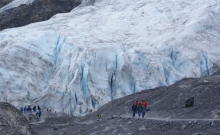
It goes without saying that warming temperatures are a threat to the world’s terrestrial ice. But it appears that as temperatures have risen and glaciers and other forms of land-based ice have receded, the effect it has had on global sea-level rise has varied by location.
A paper, due to be published in Geophysical Research Letters, a scientific journal, finds, for example, that Alaska’s mountain glaciers, while making up less than 1% of the world’s terrestrial ice volume, may contribute up to a third of sea-level rise, putting them on a par with the much lager Greenlandic and Antarctic ice sheets.
That Alaska’s glaciers are retreating rapidly has long been known; the Columbia Glacier, for example, has retreated nearly 20km since 1980.
SEE RELATED: Like watching ice melt
However, the amount of ice being lost each had been unknown, as had the effect of the two different kinds of glaciers: mountain glaciers, which terminate on land, and tidewater glaciers, which terminate in water, as the Columbia does, and can lose mass through both surface melting, as mountain glaciers, and calving.
That amount has now been calculated at 75 Gigatonnes (75 billion metric tonnes) annually (with a margin of error of 11Gt annually) between 1994 and 2013. Over the 19-year period, that would have risen the global sea level by about 4mm.
The figure was calculated my making annual airborne observations of 116 glaciers in the so-called Alaska region, which includes south-western Yukon and coastal northern British Columbia.
SEE RELATED: Warning: calving icebergs can be fatal!
Surprisingly, the scientists found that tidewater glaciers hardly contributed to sea-level rise. Instead, the largest contributor, they conclude, is the exceptionally fast loss of ice from glaciers with a terrestrial terminus.
Having a better understanding of how warmer temperatures affect glaciers will help scientists to improve their projections for sea-level rise.
Unfortunately, the study points out, the findings also indicate that those predictions will increasingly be necessary. If surface melt is the predominant driver, as the paper indicates, and if temperatures continue to increase, as is predicted, rates of loss are unlikely to decline, according to Chris Larsen, of the University of Alaska Fairbanks, and the paper’s lead author.
Alaska’s terrestrial glaciers, it appears, will keep punching above their weight, even as it continues to decline.







Most read
