
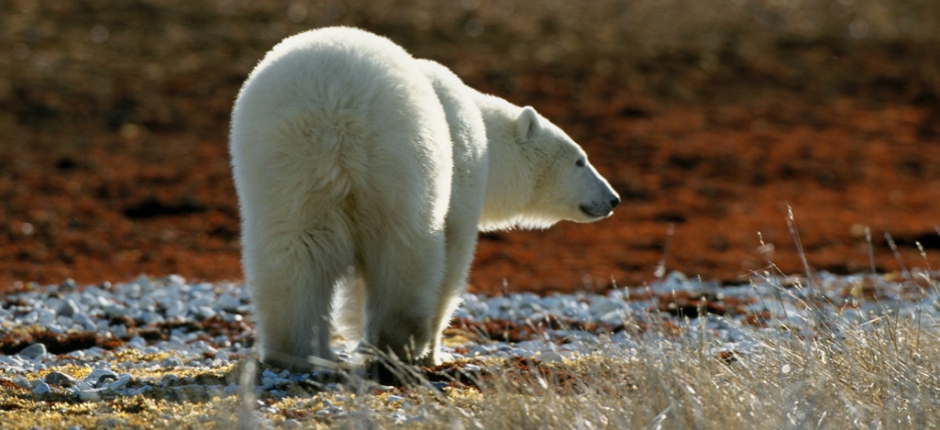
Close encounters of the polar bear kind
iAbout Press releases
As part of our continuing efforts to bring you as much information about our region as possible we offer readers a press release service that allows private firms, public agencies, non-governmental organisations and other groups to submit relevant press releases on our website.
All press releases in this section are published in their full length and have not been edited.
If you have a press release or other announcement you would like to have published, please send it to [email protected].
We reserve the right to reject press releases we deem irrelevant or inappropriate.
All material submitted to The Arctic Journal, including pictures and videos, will be assumed to be available for publication by The Arctic Journal and its related entities.
Recent encounters between polar bears and Arctic communities have scientists concerned that climate change may be forcing the world's largest land carnivore to enter urban areas more frequently in search of alternative food sources.
In the past two months, there have been two separate attacks, in the Canadian town of Churchill, a small town on the west shore of Hudson Bay and an area commonly known as the polar bear capital of the world. The attacks resulted in the injured three people.
Andrew Derocher, a professor of polar bear biology at the University of Alberta, told environmental news radio programme Living on Earth that he has observed the dangerously narrowing distance between polar bears and humans.
“It is unusual though to have people attacked in the town of Churchill itself,” he said.
Derocher explains that like the hunters from local communities, the bears require the formation of sea ice to access their prey. However, as the Arctic is warming at an accelerated rate, the ice is forming later in the year, thawing sooner and is becoming too thin to support activity.
New technologies to monitor activity
Three years ago, webcams were set up by environmental groups in the western Hudson Bay region to monitor the annual migration of the bears. The region is a renowned crossing point for polar bears returning from summers on the tundra to their winter seal hunts on the ice of the Hudson Bay.
Scientists are currently experimenting with the idea of using ‘crowdsourced’ data, meaning anyone with an internet connection will be able to contribute information about the animals’ annual migration in Canada.
The new feature on Explore.org will allow users to watch the live feed and capture individual images to download or share on social media sites.
SEE RELATED: Thin times for polar bears
Steven Amstrup, chief scientist for Polar Bears International, told Sci-Tech Today, a science news website, that the new technology may help with climate research and detecting the changes in polar bear size, health and reproductive rates.
“We need to explore the potential to collect data from whatever sources might be out there,” he said.
Once the best images are collected, scientists will then compare the results with their photo archives to gain a better understanding of the changes to the bear’s conditions.
Not looking good for the Arctic nomads
Aside from the concerns for the safety of local communities, scientists also have grave concerns for the health and longevity of the bears.
Populations are generally stable, however “we’re seeing changes in sea ice, and we think that we’re on the cusp of changes in the next population north”, Derocher said.
There are presently 19 populations of polar bears, and some may have to face more drastic changes to their environment than others.
SEE RELATED: Making polar bears dangerous again
The concern, according to Derocher is that climate change will affect each population differently.
The worst off populations right now, he said, are in the Beaufort Sea off Alaska, while the western Hudson Bay is “in dire straits”.
“We’ve got serious concerns about other ones, the Davis Strait population off of Labrador and Newfoundland – collectively it’s not good for the bears.”






Most read
