Jurassic flu
iAbout Press releases
As part of our continuing efforts to bring you as much information about our region as possible we offer readers a press release service that allows private firms, public agencies, non-governmental organisations and other groups to submit relevant press releases on our website.
All press releases in this section are published in their full length and have not been edited.
If you have a press release or other announcement you would like to have published, please send it to [email protected].
We reserve the right to reject press releases we deem irrelevant or inappropriate.
All material submitted to The Arctic Journal, including pictures and videos, will be assumed to be available for publication by The Arctic Journal and its related entities.
Firstly, we should reassure our readers that the giant virus discovered by French scientists and reported on in the world’s media yesterday is not dangerous to humans. Just amoebas.
That said, the scientists that brought the 30,000-year-old organism back to life in a lab and then returned to its original infectious state said it should be seen as a harbinger the potential dangers associated with warming temperatures.
“The revival of such an ancestral amoeba infecting virus … suggests that the thawing of permafrost either from global warming or industrial exploitation of circumpolar regions might not be exempt from future threats to human or animal health,” the team from the Centre National de la Recherche Scientifique at Aix-Marseille University that made the discovery wrote in the Proceedings of the National Academy of Sciences.
VIDEO: Permafrost: The Tipping Time Bomb (At end of article)
Thawing permafrost is nothing new. And it has long been understood that when it thaws, it poses some problems for people.
In addition to wreaking havoc with infrastructure and leading to the degradation of archaeological and paleontological finds, thawing permafrost releases trapped methane, which only accelerates the process of climate change.
To understand permafrost, think of a freezer. A giant one. One that underlies an estimated 20 percent of the world’s soil. And when you open the door of that freezer for long enough it begins to warm up and everything that is inside it thaws.
At current rates of temperature increases, the real-world permafrost freezer could shrink by 90 percent by the end of the century, scientists say.
SEE RELATED: Alaska no longer perma[nently] frosty
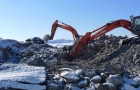
For mining companies and even some scientists this is something of a boon. But any enthusiasm about improved access to raw materials and the genetic and paleontological record are tempered by what some scientists say is a “major threat” to humans.
So far the prospect of an Arctic version of ‘Outbreak’, a 1995 medical-disaster film about a virus suddenly awoken in the African jungle, remains in the realm of science fiction. But the possibility that the Arctic and sub-Arctic could become a crucible of pathogens is the stuff of serious research.
One of the studies looking into the dangers of thawing permafrost is PERMATHREAT, an EU-funded project underway since 2012. The project has identified organic material that has been frozen for thousands of years – 500,000 years to be more precise. Some of that material comes from virus and bacteria.
Should widespread thawing of the permafrost take place, it could result in “vast amounts of new antibiotic-resistant” genetic material being released, the official project description says.
SEE RELATED: Climate change a blessing and a curse for archaeologists
In order for that material to become harmful it would somehow need to enter back into the gene pool. The prospect of a complete virus or bacteria being revived by warming temperatures, as in the French lab experiment, is unlikely, according to scientists. More realistic they say is the possibility that a modern virus or bacteria species incorporated the ancient DNA into their own.
So far the project has seen no evidence of this happening, but the consequences of the hypothetical situation becoming reality would be serious, according to Uffe Wilken, of the Center for GeoGenetics at the University of Copenhagen, which is co-ordinating the programme.
“Living bacteria today could incorporate these genes and spread pandemics for which present day organisms have lost immunity.”
Defending against ancient viruses might be impossible, but the French researchers say it is worthwhile to continue working to assess the threats. The best method of doing so, they said, was to count the number of pathogens found in permafrost samples.