Uncertain forecasts
iAbout Press releases
As part of our continuing efforts to bring you as much information about our region as possible we offer readers a press release service that allows private firms, public agencies, non-governmental organisations and other groups to submit relevant press releases on our website.
All press releases in this section are published in their full length and have not been edited.
If you have a press release or other announcement you would like to have published, please send it to [email protected].
We reserve the right to reject press releases we deem irrelevant or inappropriate.
All material submitted to The Arctic Journal, including pictures and videos, will be assumed to be available for publication by The Arctic Journal and its related entities.
Factfile | Predicting September Sea Ice
The study, Predicting September Sea Ice: Ensemble Skill of the Search Sea Ice Outlook 2008–2013, analysed forecasts from the Study of Environmental Arctic Change (SEARCH) Sea Ice Outlook, a project that gathers and summarises sea ice forecasts made by sea ice researchers and prediction centers.
Contributors to the SEARCH Sea Ice Outlook project employ a variety of techniques to forecast the September sea ice extent, ranging from heuristic, to statistical, to sophisticated modeling approaches.
The National Science Foundation and the Office of Naval Research supported the study.
Attachments

Increasing commercial and research activity in the Arctic has brought with it a growing need for short-term predictions of ice levels. New research shows, however, that producing accurate forecasts remains elusive.
A study of 300 summer Arctic sea-ice forecasts made between 2008 to 2013 and found that the predictions were highly accurate when sea ice conditions were close to the downward trend that has been observed over the past 30 years.
However, the research, carried out by scientists at the National Snow and Ice Data Center (NSIDC), University College London, University of New Hampshire and University of Washington, found that the forecasts were inaccurate when sea-ice levels were unusually higher or lower than the norm.
“We found that in years when the sea ice extent departed strongly from the trend, such as in 2012 and 2013, predictions failed regardless of the method used to forecast the September sea-ice extent,” said Julienne Stroeve, a senior scientist at NSIDC and professor at University of College London. Stroeve is lead author of the study, to be published in the forthcoming issue of Geophysical Research Letters.
SEE VIDEO: Watch the Arctic’s old ice melt away (at end of article)
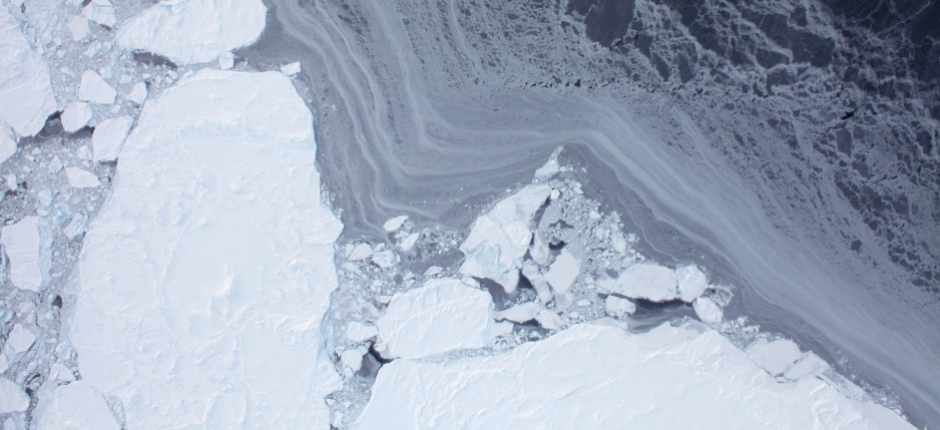
Arctic sea-ice expands throughout the winter and contracts in the summer, reaching its minimum extent in September. As the global temperature has warmed the overall amount of ice lost during summer months has outstripped the amount gained during the winter.
Long-term predictions of summer Arctic ice extent made by global climate models suggest that the downward trend will likely lead to an ice-free Arctic summer in the middle of the century. These models are in overall agreement on loss of Arctic summer sea ice as a result of anticipated warming from the rise in greenhouse gases this century.
Annual variations in ice levels and the amount of ice lost can occur, just as some summer ice levels can exceeding the amount the previous year, even as the long-term trend is towards less ice. It is those oddball years that can be especially “hard to pin down”, said Lawrence Hamilton, one of the report’s co-author and a researcher at the University of New Hampshire.
SEE RELATED: Arctic ice rebound not a sign of recovery, experts warn
Traditionally, assessments of Arctic ice have focused on the extent of Arctic ice – how much area it covers – typically immediately prior to the summer melt season. Recent studies have looked at the thickness of the ice, as well as the amount of multi-year ice – ice which survived at least one summer melt – and, according to the report, such methods could improve seasonal forecasts.
“It may even be possible to predict sea ice cover a year in advance with high-quality observations of sea-ice thickness and snow cover over the whole Arctic,” said Cecilia Bitz, another of the study’s co-authors and a professor of atmospheric sciences at the University of Washington.
Stroeve agreed that short-term predictions were achievable, even if challenges remain when it came to predicting outlier years. One of those challenges is a lack of data, while another, she said, is somewhat more mundane. “Of course there is always the issue that we cannot predict the weather, and summer weather patterns remain important.”