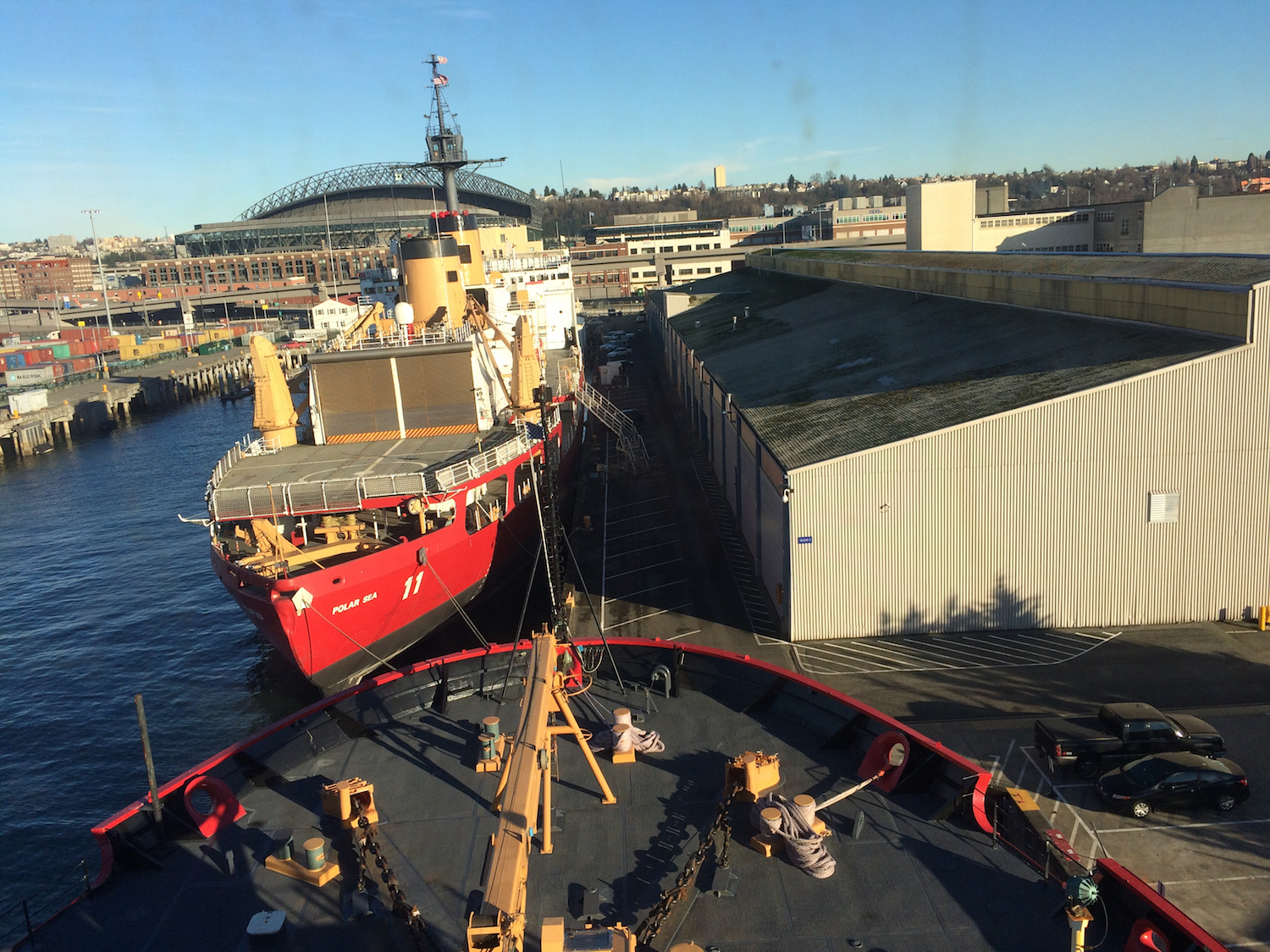
The ‘Healy’ in action (and inaction)

iAbout Press releases
As part of our continuing efforts to bring you as much information about our region as possible we offer readers a press release service that allows private firms, public agencies, non-governmental organisations and other groups to submit relevant press releases on our website.
All press releases in this section are published in their full length and have not been edited.
If you have a press release or other announcement you would like to have published, please send it to [email protected].
We reserve the right to reject press releases we deem irrelevant or inappropriate.
All material submitted to The Arctic Journal, including pictures and videos, will be assumed to be available for publication by The Arctic Journal and its related entities.
Normally, says Captain Gregory Stanclik, you can get a good night’s sleep on the USCGC Healy, a coast-guard icebreaker. Except when the ice gets particularly thick and the ship needs to repeatedly ram the ice, back up, and then ram it again. (SEE VIDEO BELOW.)
“Then you can feel it shudder. But just a little,” Stanclik, the ship’s second in command, says.
Cruising speed for the Healy, which is powered by four 12 cylinder engines capable of putting out a total of 30,000 horsepower, is three knots in ice that is 1.5 metres thick. If things are going well, it can make 16km an hour.
“But there are days when we’ve hit ice that has slowed us to a mile (1.6km) a day,” Stanclik says.
When the going gets tough (and the sleeping difficult) the ship must reverse a distance of three ship lengths, and then plough forward in a process it repeats until it can make headway.
Right now, the only progress being made on the Healy is with its renovation. Currently in its home port of Seattle, it is undergoing scheduled maintenance. Instead of ice, its biggest obstacle appears to be the work crews overhauling labs, propulsion systems and other parts of the ship, and otherwise making the Healy ready for its next trip north, expected in June.
SEE PHOTO GALLERY after video (More pictures available on our Facebook page)
At that time, as many as 50 scientists will join the permanent contingent of 90 coastguardsmen who call the ship their workplace. From the time they leave Seattle until the time they return, in October, it is also their summer home.
During the summer months in the Northern Hemisphere, the vessel, whose construction was partly funded by the National Science Foundation, a federal agency, functions as a floating lab, sailing from either Dutch Harbor or Barrow, both in Alaska, that can be at sea for up to 150 days.
Built in 1999, the Healy, America’s newest icebreaker, is approaching middle-age, according to Stanclik. As a science vessel, it mainly sticks to the Arctic. In the past it has helped with icebreaking in the Antarctic, but due to its hull shape it is better suited to the straight-ahead sailing of the Arctic, rather than the zig-zagging required in the Antarctic.
And, perhaps, better suited for sleeping.
The tour of the Healy was organised as part of the Arctic Encounter Symposium.
Backing & Ramming from Ben Harden on Vimeo.
healy-bridge-2.jpg

healy-phones.jpg

healy-boiler-plate.jpg

healy-engineering.jpg

healy-pistons.jpg

healy-from-land.jpg

healy-ladders-crop.jpg

healy-labs.jpg

healy-ctd.jpg

healy-lab-sign.jpg

healy-polar-sea-2.jpg

healy-polar-sea-3.jpg