From resource to nuisance
iAbout Press releases
As part of our continuing efforts to bring you as much information about our region as possible we offer readers a press release service that allows private firms, public agencies, non-governmental organisations and other groups to submit relevant press releases on our website.
All press releases in this section are published in their full length and have not been edited.
If you have a press release or other announcement you would like to have published, please send it to [email protected].
We reserve the right to reject press releases we deem irrelevant or inappropriate.
All material submitted to The Arctic Journal, including pictures and videos, will be assumed to be available for publication by The Arctic Journal and its related entities.
For half the year, polar bears are a valuable resource for the people of Ittoqqortoormiit, a town of 450 on Greenland’s eastern coast. For the other half, they are mostly a nuisance.
That is because an influx of bears, most likely caused by thinning sea ice, means that the town’s hunters exhaust their quota, this year 35 bears, by late spring. Once quotas have been used up, bears may only be shot in self-defence, but the animal’s remains are then confiscated by national authorities.
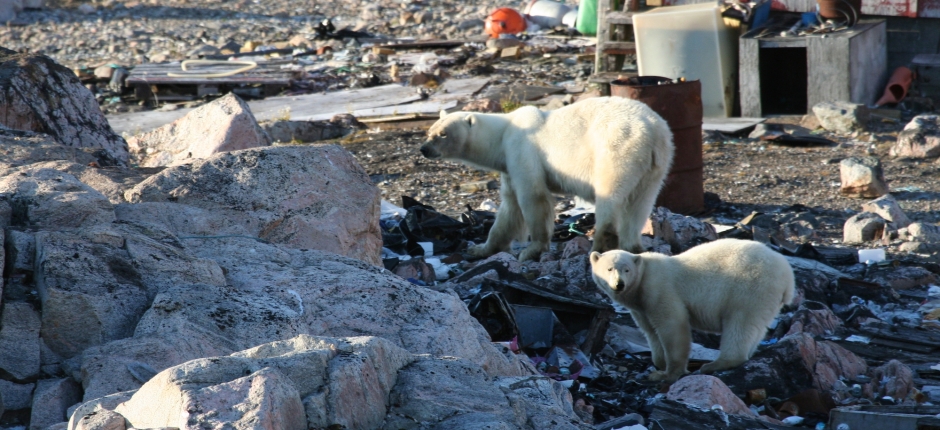
Polar bears typically spend most of their time at sea, preferring to hunt seal from the edge of sea ice. But as sea ice recedes and thins, they are increasingly coming ashore, in Greenland as elsewhere, to find food, especially in the summer.
SEE VIDEOS: To feed and to fear (at end of article)
But whereas other regions, including Nunavut, Alaska and Russia, have reacted to the development by doing things like establishing patrols that can scare bears off before they get too close, in Ittoqqortoormiit, organised efforts have failed to materialise. Often times, people throw stones at bears that come too close, or, in some cases, slap them.
This typically works, but they scare bears off only temporarily. Bears that continue to come back get labelled as nuisances and tend to end up being shot and killed.
In order to come up with a more effective preventive and humane approach, some Ittoqqortoormiit residents have sought the advice of WWF, a conservancy, which has helped institute programmes in other areas where encounters between humans and polar bears are on the rise.
Most of the tools organisation representatives suggested during town meetings in May tended towards the low-tech: better lighting and improved storage of dog food. More formally, WWF has agreed to help secure funding for regular polar-bear patrols issued with non-lethal rubber bullets and more flares.
SEE RELATED: Polar-bear country
In order to make visitors aware of the presence of polar bears, the organisation further recommends ensuring there is adequate signage to warn visitors of, for example, routes most travelled by polar bears within the community.
Similar measures, according to Stephen DeVincent, a veterinarian who has worked on polar bear issues for the US State Department, have worked elsewhere, and typically bring with them multiple benefits. The immediate effect, he notes, is that people start feeling safer. Then, with fewer bears being killed unnecessarily one year, hunters may also benefit, since potentially more bears will be available to hunt the next year if fewer were killed in the area in the preceding year.
For the bears themselves, being kept further away from humans will reduce the chances of an untimely end. DeVincent, however, notes that it should not overshadow efforts to address the greater threat of habitat loss.
“Doing all this work to save polar bears, both as a resource for subsistence hunters and as a means to avoid conflict killings, is necessary,” he says, “but it requires that we do something to mitigate the long-term impacts of climate change. That’s why they are coming ashore in the first place.”
SEE RELATED: A symbol, but of what?
Equally noteworthy is that in seeking to address its polar-bear problem, Ittoqqortoormiit invited WWF to offer suggestions.
A rarity among conservation groups, WWF gets a good reception among residents of Greenland and other Arctic regions. This, according to John Nordbo, the head of conservation for the group’s Danish chapter, and who was present during last month’s meetings, has to do with its principle of incorporating local knowledge when forming its policies.
“Co-operation is easier when people can hear that we know what we’re talking about, and that they can trust us as a serious organisation,” he says. “This is something we’ve built up over many years, and we’re pleased that people receive us well.”
Even so, DeVincent explains that conservation, even for an organisation with a good reputation, can be a difficult sell.
“People may be receptive to suggestions, but there is always the potential to feel that this is someone from the outside telling them what to do. What they see is that there are more polar bears, but what they hear is that they should not shoot them. That’s often hard to accept.”
VIDEO: Polar bears scavenging in eastern Greenland
VIDEO: Woman from eastern Greenland explains her thoughts about increasing number of run-ins between humans and polar bears