Future of Arctic not as smooth as it appears
iAbout Press releases
As part of our continuing efforts to bring you as much information about our region as possible we offer readers a press release service that allows private firms, public agencies, non-governmental organisations and other groups to submit relevant press releases on our website.
All press releases in this section are published in their full length and have not been edited.
If you have a press release or other announcement you would like to have published, please send it to [email protected].
We reserve the right to reject press releases we deem irrelevant or inappropriate.
All material submitted to The Arctic Journal, including pictures and videos, will be assumed to be available for publication by The Arctic Journal and its related entities.
One the final day of the inaugural Arctic Circle conference, the first signs of cracks began to appear in what has been a veneer of general consensus about the future of the region.
Discussions here the past three days have primarily dealt with top-shelf issues like security, trade and climate. Indigenous issues have been on the programme, but, in the corners, groups representing them have been murmuring that they had not been as prominent as they should have been.
Agreed. "@arctic_journal: Overheard: The #ArcticCircle is a way for 'southerners' to explain why they should get a slice of the Arctic."
— Jeanette Doucet (@Momforchoice) October 13, 2013
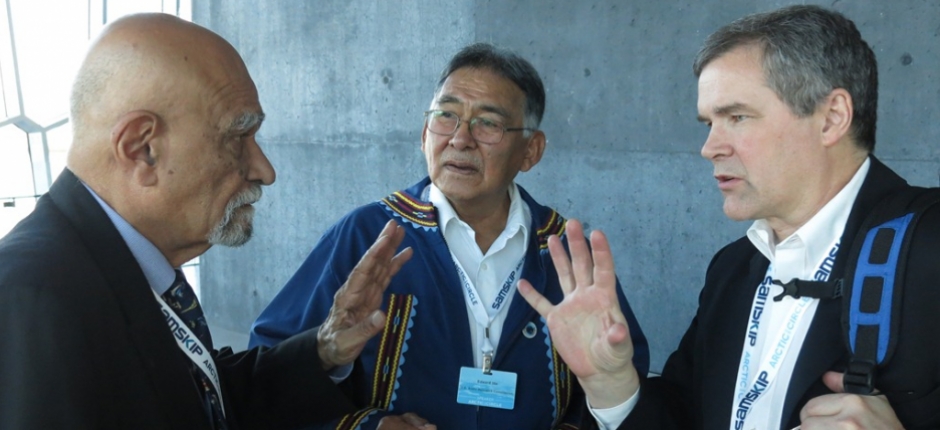
Those concerns were voiced aloud today by Aqqaluk Lynge, the president of ICC, an international Inuit group. During a discussion with high-profile Arctic figures about the future of the region, he expressed his fear that as a “a minority within their own territories” the Inuit would “be run over” by outside groups.
“It is important in the new Arctic that the Inuit control the resource development in their territories and start on a footing of honesty, integrity and transparency,” he said. “It is important that the new Arctic does this differently than before.”
Indigenous legitimacy
Sven Roar Nystø, a former president of Sámediggi, Norway’s Sami parliament, earlier in the weekend criticised the limited involvement of indigenous groups here. Here on the final day, however, he said it appeared that the conference had cemented the “legitimate interest and right” of indigenous peoples to the Arctic.
“It’s recognised now that we belong at the table during political discussions about Arctic development and climate change,” he said.
For some members of indigenous groups, particularly those not representing their nations, the concern about indigenous involvement was less apparent.
“The discussion has had an underlying tone of the Arctic as a common good for the people of the planet,” said Minik Rosing, a native Greenlander who is a prominent geologist with the University of Copenhagen. “Everything we do here has taken into account the day-to-day happenings in the Arctic.”
Progreess through education
Kuupik Kleist, a native Greenlander who joined the board of the conference after losing his bid for a second term as that country’s premier in 2011, expressed a similar sentiment.
“Looking around this room, it’s clear that what we’ve been wishing for over the last few decades has finally become a reality,” he told attendess.
The statement reiterated comments he made earlier in the weekend, but here on the last day, he also expressed concern that commercial development might not benefit the people living in the Arctic.
“Lofty discussions about Arctic affairs don’t always consider daily lives of Arctic residents,” he said.
He called on groups benefitting from their activities in the Arctic to put something back into the region, adding that he felt there was one clear area they should support.
“Education. Please devote some of your powers, your economic strength, your endeavours to advancing the education of the Arctic people.”
It would be in keeping with the spirit of the weekend if the organisations he was supported him whole-heartedly. Those on whose behalf he was speaking, however, will no doubt remain unconvinced.