Sleepless on the ‘Saputi’
iAbout Press releases
As part of our continuing efforts to bring you as much information about our region as possible we offer readers a press release service that allows private firms, public agencies, non-governmental organisations and other groups to submit relevant press releases on our website.
All press releases in this section are published in their full length and have not been edited.
If you have a press release or other announcement you would like to have published, please send it to [email protected].
We reserve the right to reject press releases we deem irrelevant or inappropriate.
All material submitted to The Arctic Journal, including pictures and videos, will be assumed to be available for publication by The Arctic Journal and its related entities.
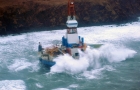
It was a collision with a five-metre long clump of ice that did the Saputi in. The Canadian fishing vessel rammed sea ice at around 10pm on the night of February 20 while it was working the Davis Strait.
The hours and days that followed were more dramatic than the crew cares to remember. For Captain Wayne Mansfield, for example, it wound up being an experience that included 44 hours without sleep, a cargo drop by the Canadian coast guard and, finally, an escort into Nuuk by a Danish naval vessel and a rescue helicopter.
Going back to that Saturday night, had you told the crew of Saputi in the moments before the collision that it was going to end that way, none of them would have believed you.
“The weather was clear in the area where we were fishing Saturday night and there were no icebergs near by,” Mr Mansfield says. “Even when we hit the ice, the ship didn’t shake much. But, we hit head on as we were coming down from a wave while the ice was rising to the surface.”
The chunk of ice, Mr Mansfield reckons, measured five metres long and no more than four metres wide, but it hit the Saputi head on, on the starboard side.
“We were only sailing at 2.9 knots at that time, but you could really hear it when we hit.”
SEE VIDEO of the Canadian coast guard dropping reserve pumps to the Saputi
About 15 minutes after the impact, the engine room informed the bridge that they were taking on water. The collision had ruptured the ship’s hull near the main storage compartment. There was no hole, but the rupture was big enough to be letting in water.
“We were taking on water fast, but I wasn’t afraid we were going to sink. I was more worried about the safety of the crew, and I ordered them into their survival suits. Everyone had been through survival training, but it took a little while before they realised just how serious the situation was. At that point we still thought we could pump the water out faster than it was coming in,” Mr Mansfield says.
The Saputi sent out a distress signal to the Canadian coast guard, who in turn informed the Danish authorities in Nuuk. By then, the situation on board had become serious. The crew was now aware that the water was coming in too fast for their pumps to keep up with. A Canadian cargo plane was dispatched to drop pumps to the ship. The mission was a success, but it turned out the extra pumping capacity was insufficient.
“The hold was still filling with water, so the next thing we did was to secure all hatches leading into the hold in order to contain the water there. There was still air in the hold when closed the hatches, and combined with the water, it meant that each time we went over a wave the hatches came under enormous pressure. We had to work hard to make sure they stayed closed,” Mr Mansfield says.
SEE RELATED: SAREX commander steering rescue crews towards disaster
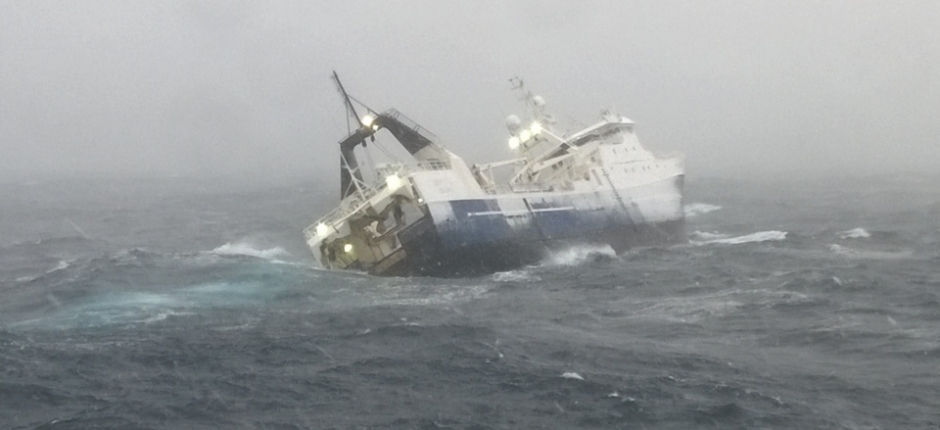
At that point, Nuuk was the closest port that had a shipyard that could repair the damage that had been done. As luck would have it, bad weather was approaching from the east, and with the ship tilted perilously at an angle of 40°, the crew were in for a rough ride.
Before long, the Knud Rasmussen appeared. None of the Saputi crewmembers had been injured, but some were starting to panic. With the weather worsening, it was decided to transfer the crewmembers who were in worst shape to the Danish vessel. At the same time, three members of the Kund Rasmussen’s crew went on board the fishing vessel to lend a hand.
“We transferred as many as possible, and decided to leave behind just a skeleton crew. If the situation got worse and we needed to be evacuated, there would be fewer of us that needed to be rescued,” Mr Mansfield says.
Weather wasn’t the ship’s only problem. The damaged hull meant the Saputi couldn't manoeuvre properly. Because it was tilting, it couldn’t turn quickly, and with 45 knot winds and seven-metre seas, everything the ship did had to be slow and well timed.
“That was when we started to worry that we were going to take on water from above,” Mr Mansfield says.
SEE RELATED: An ounce of prevention is worth a pound of SAR
By then the only option was to continue towards Nuuk. The Knud Rasmussen’s boat had ruptured a pontoon, meaning no more of the Saputi’s crew were going to get off that way, and the worsening weather was forcing the helicopter to remain on land.
“Our only way out of the situation was sailing to Nuuk.”
The Saputi eventually made it to port and it is currently being repaired. The crew have since been flown back to their families in Canada. Mr Mansfield, for his part, doubts either would have been possible without the help of the Canadian coast guard or the Danish navy.
“The most important thing the whole way though was good communication,” he says.
The author reports for AG, a Greenlandic weekly published by this website’s parent company.