The sounds of uncertainty
iAbout Press releases
As part of our continuing efforts to bring you as much information about our region as possible we offer readers a press release service that allows private firms, public agencies, non-governmental organisations and other groups to submit relevant press releases on our website.
All press releases in this section are published in their full length and have not been edited.
If you have a press release or other announcement you would like to have published, please send it to [email protected].
We reserve the right to reject press releases we deem irrelevant or inappropriate.
All material submitted to The Arctic Journal, including pictures and videos, will be assumed to be available for publication by The Arctic Journal and its related entities.
As the debate in Nunavut rages over the impact of planned seismic testing in Baffin Bay, biologists in Greenland say the jury is still out on the effects similar activity being conducted there.
Greenland’s Self-Rule authority gave the go-ahead to begin seismic testing in the country’s portion of Baffin Bay in 2009. Like in Nunavut, testing is being carried out in order to map the underground in preparation for possible oil drilling.
In order for oil firms to know where to drill, they must have a clear picture of what lies below the ocean floor. Doing that requires using sound waves to create a map of the underground.
Those sound waves – loud pulses of low-frequency sound fired from an airgun towed by a ship – are suspected of possibly causing injury to animals and disturbing behaviour patterns.
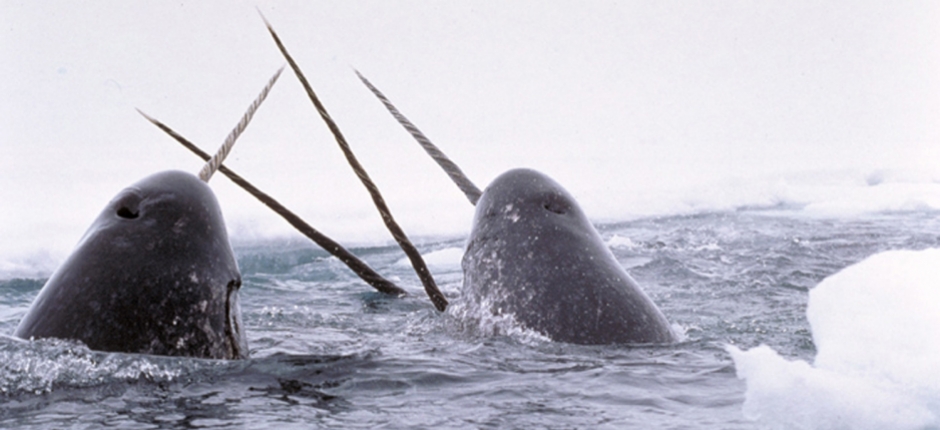
SEE VIDEO: Learn what the unicorn of the sea uses its horn for (at end of article)
Studies of the effects of seismic testing on marine mammals in other parts of the world have shown a possible link to altered foraging behaviour, migration patterns as vocalisation. So far, however, it has been impossible to conclude whether whale populations in Greenland’s Baffin Bay have been affected.
Prior to the testing, no studies of the effects of seismic activity on Greenland’s marine animals had been carried out. But in 2012, with four simultaneous seismic surveys planned that year the Danish Centre For Environment and Energy (DCE), together with the Greenland Institute of Natural Resources (GINR), at the behest of Greenland’s Self-Rule authority, conducted three different types of studies in order to assess what impact it was having on narwhales in Baffin Bay.
The preliminary results of the studies, released last year, conclude that there was no evidence that seismic activities have had any short-term impact. Even so, the GINR and the DCE say they have reservations about continued seismic testing.
Although the biologists noted that hunters interviewed as part of one of the studies had not noticed changes in narwhal populations, they recommended that if seismic studies were to continue then more studies would be needed.
Likewise, the report also underscored that aspects such as behaviour had not been looked at.
SEE RELATED: Whales finding it harder to find romance
In their evaluation the two organisations said they were “concerned” about the effect additional testing could have, saying that the inconclusive result should not be taken as a sign that no damage was being done.
“‘Proceed with caution’ must be the overriding principle here,” they wrote in their evaluation.
Greenland has long taken a cautionary approach to seismic testing, and that, according to Line Kyhn, a biologist with the DCE, has led to some of the strictest regulations in world.
What makes them strict, she says, is a requirement that firms model their own expected noise pollution in their environmental impact assessments, and that they must document their actual exposure during their surveys.
In addition, if several companies are seeking to carry out seismic testing in the same general area, as was the case in Baffin Bay, they must jointly submit a cumulative noise exposure model.
SEE RELATED: Greenpeace activists protest at Shell refinery
The regulations, she says, are unique to Greenland. Scientists say they benefit from the rules, since it provides them with access to predicted noise levels for an entire seismic project and allow them to develop better ways to model the impact of testing.
Other Greenlandic regulations, which are also in place in other countries, require that firms seek to identify whether marine animals are in the area where a ship intends to carry out seismic testing.
Testing may not begin if a spotter observers a marine mammal within 500m of the ship. If an animal is spotted within 200m of a ship conducting testing, the volume of the sound must be lowered until the animal swims off.
Similarly, ships must gradually increase the volume of the seismic waves when starting testing runs. This gives animals time to leave the area where testing is being conducted.
Such rules, says Kyhn, are designed to protect individual animals from injury, but of greater concern for biologists is the long-term effect on overall populations. This is of particular concern, since narwhal populations in Greenland have rebounded in recent years.
SEE RELATED: For Scots, Greenland a gamble worth taking
One of the worries is that marine animals exposed to loud noises will migrate out of an area where the sound is being made. In the case of fish, this could lead to falling catches for fishermen. In the case of whales, it could make it difficult for hunters to maintain their livelihood.
So far, the evidence indicates that narwhales, appear not to have been affected. However, one of the findings of the 2012 studies was an increased tendency for the whales to cluster than had been observed during the most recent census, conducted in 2007.
There was no indication why, and was cited by the two organisations as one of the primary reasons why further studies were needed.