Tilting at drilling rigs?
iAbout Press releases
As part of our continuing efforts to bring you as much information about our region as possible we offer readers a press release service that allows private firms, public agencies, non-governmental organisations and other groups to submit relevant press releases on our website.
All press releases in this section are published in their full length and have not been edited.
If you have a press release or other announcement you would like to have published, please send it to [email protected].
We reserve the right to reject press releases we deem irrelevant or inappropriate.
All material submitted to The Arctic Journal, including pictures and videos, will be assumed to be available for publication by The Arctic Journal and its related entities.
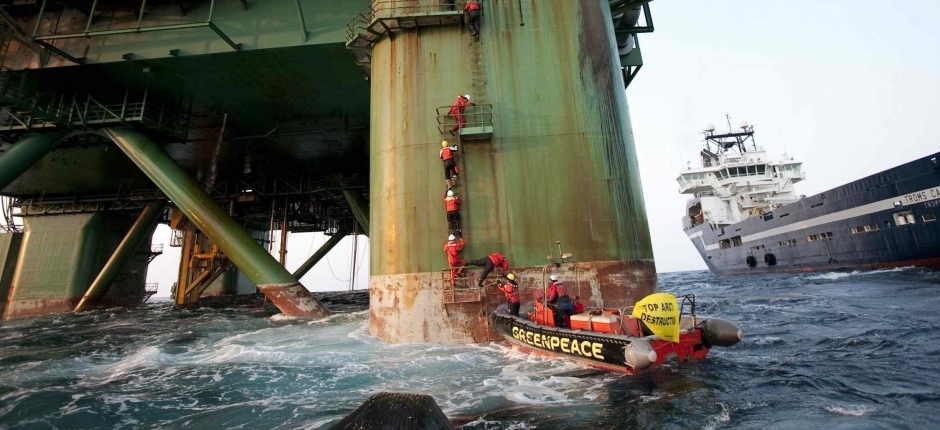
A new headline seems to pop up every day: Greenpeace activists occupy Danish refinery. Russian coast guard boards Greenpeace ship. Greenpeace boards Arctic oil platform (see video below). Greenpeace activists hang glide into Formula One race in Belgium to protest oil drilling in the Arctic.
But are the actions drawing attention to the issue of Arctic drilling or merely PR stunts generating mostly publicity and contributions for Greenpeace? Are they really “shining a light on Shell’s actions in the Arctic”, as they claim or are they shining that light mostly on themselves?
Although the crew of the Greenpeace icebreaker Arctic Sunrise was initially defiant after being bordered by the Russian coast guard in the Kara Sea earlier this month, they backed down quickly after what they called “threats of force” by the authorities.
Size and methods under attack
Greenpeace’s confrontational methods have been the object of some criticism in recent years, as has the organisation’s size.
The Social Institute Research Centre (SIRC), an independent issues-based think tank based in the UK, wrote that Greepeace’s constant media presence and guerrilla-like techniques are actually creating a sea change in press coverage from what SIRC called a previous “pious deference” to hard questions about Greepeace’s actions.
Charles Secrett, the head of Friends of the Earth in the UK, has openly questioned Greenpeace’s tactics, like chaining themselves to a drilling rig – something they did off the Greenlandic coast 2010 and 2011 and in Russian waters last year – saying they take pressure off of governments and businesses by forcing people to discuss tactics, rather than issues.
Moreover, Greenpeace, which has an annual budget of over $100 million, recently failed to regain its charitable status in Canada, its country of origin, where authorities concluded that the group “performed no public function”.
Greenpeace stays the course
Even with its green halo a little tarnished, the organisation, according to Neils Fuglsang, the head of Greenpeace Denmark’s campaign against Arctic drilling, still plays a vital role.
Fuglsang said Greenpeace’s actions are helping to raise worldwide awareness about the dangers of drilling for oil in the Arctic and inspiring people to learn about a part of the world that they may know very little about.
“Besides raising awareness, these actions actually raise the cost of drilling,” he said. “The more expense that we can create for these companies, the more we can achieve our aim of stopping drilling in the Arctic.”
SEE RELATED: Interview with an activist
Fuglsang disagreed that the publicity surrounding actions like one at a Shell refinery in Denmark and the Russian confrontation were not having the desired effect.
“The comments we hear are generally positive and praise our non-violent and generally non-destructive methods,” he said.