A culmination of sorts
iAbout Press releases
As part of our continuing efforts to bring you as much information about our region as possible we offer readers a press release service that allows private firms, public agencies, non-governmental organisations and other groups to submit relevant press releases on our website.
All press releases in this section are published in their full length and have not been edited.
If you have a press release or other announcement you would like to have published, please send it to [email protected].
We reserve the right to reject press releases we deem irrelevant or inappropriate.
All material submitted to The Arctic Journal, including pictures and videos, will be assumed to be available for publication by The Arctic Journal and its related entities.
Last week marked something of a breakthrough in international politics for Greenland. During GLACIER, a US State Department-sponsored event held in Anchorage on Monday, August 31. The meeting saw Vittus Qujaukitsoq, the foreign minister, seated amongst the representatives of sovereign states as they discussed the politics of the region and the effects that a changing climate is having on the Arctic.
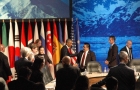
Mr Qujaukitsoq (greeting Barack Obama, above) was participating as part of the delegation from the Kingdom of Denmark, together with Kristian Jensen, Denmark’s foreign minister. The event brought him in contact with John Kerry, America’s secretary of state, and saw him not just take part in closed-door discussions amongst diplomats but also address the gathering.
When it comes to foreign policy, Greenland and Denmark appear to have found a workable partnership, and particularly Messrs Qujaukitsoq and Jensen (above, right) appear to work well with each other, just as the foreign ministries in Nuuk and Copenhagen seem to be able to co-operate to effectively.
SEE RELATED: In the name of Nuuk
Further, since taking office in June, Mr Jensen has shown himself to be willing to accommodate Greenland’s foreign-policy ambitions.
Greenland has the enviable position of both being able to follow its own foreign-policy course while at the same time being able to count on the support of Danish diplomats. When Copenhagen finds itself at odds with Nuuk, it is the Danes that generally yield. In the past, we have seen Denmark speak Greenland’s case in the International Whaling Commission and in the EU, where disputes over fishing and seal hunting have arisen in recent years.
Greenland is of course not unaccustomed to sitting in during such discussions in the Arctic Council, but Mr Qujaukitsoq’s appearance at GLACIER represented a culmination of sorts for the Danish-Greenlandic foreign-affairs partnership.
That is because, initially, Greenland had been left off the list of invitees. That America’s diplomats in Copenhagen failed to make sure that Washington include officials Nuuk can seem odd; whenever Washington needs to talk about Thule, its air-force base in northern Greenland, it knows where to go, and when it shows up, there is no end to what American diplomats are willing to do – or say they are willing to do, at least.
SEE RELATED: Editor’s Briefing | Foreign relations in the Kingdom of Denmark
Such was the case in 2004, when Colin Powell, then America’s secretary of state, and Josef Motzfeld, Greenland’s premier at the time, signed the Igaliku Agreement, which dealt with modernisation of the base. Yet when it comes to talking about climate change in the Arctic, involving Nuuk was apparently not necessary.
Thanks to good working relationship between the two foreign ministries, Greenland wound up not just with an invite to Anchorage, it was found itself involved in the discussion.
Though Alaska may have been the high-point of Danish-Greenlandic foreign policy co-operation, it is far from a solitary occurrence. Most recently, we saw Kim Kielsen, Greenland’s premier, travel to Japan this spring together with the Danish royal couple as part of a trade delegation. The visit, which had been in the works for a number of years, involved a handful of well-attended events organised by the Danish embassy together with the Self-Rule Authority.
Again, the collaboration showed that Danish diplomats were willing to do what they could to help Nuuk and to promote its commercial and cultural interests.
SEE RELATED: Increasingly independent, diplomatically speaking
The only marks against Greenland’s participation in GLACIER may have been that Mr Qujaukitsoq was neither included in the so-called family photo of attending foreign ministers (from Arctic and non-Arctic states) nor was he seated at Mr Kerry’s table during the opening dinner for foreign ministers on the Sunday before the event started.
This is particularly worth noting given that, as the Arctic Council has added observers, there has been a constant fear amongst indigenous groups, represented by six permanent-participant organisations, that their role will be diminished in if more countries become involved.
That is partly because governments, first and foremost, like to deal with other governments, and that opens up the possibility that indigenous groups will get overlooked as members and observers negotiate matters of political importance.
Aleqa Hammond, Greenland’s previous premier, might have had a point when she boycotted the Arctic Council for a period in 2013. Unfortunately, just what she was protesting against, and what she wanted to achieve by staying away from meetings, was never clearly formulated. In most people’s eyes, it was a clumsy attempt to play political hardball. That does not, however, mean that it was entirely misplaced.
The author is the editor-in-chief and managing director of SermitsiaqAG, the parent company of this website.