Citizen Arctic
iAbout Press releases
As part of our continuing efforts to bring you as much information about our region as possible we offer readers a press release service that allows private firms, public agencies, non-governmental organisations and other groups to submit relevant press releases on our website.
All press releases in this section are published in their full length and have not been edited.
If you have a press release or other announcement you would like to have published, please send it to [email protected].
We reserve the right to reject press releases we deem irrelevant or inappropriate.
All material submitted to The Arctic Journal, including pictures and videos, will be assumed to be available for publication by The Arctic Journal and its related entities.
The new direction in geo-politics is, judging by the sentiment during the 31st annual session of the West Nordic Council, a regional co-operation group, far north by west Nordic.
Since its founding in 1985, the regional group has sought to identify common issues facing the Faroe Islands, Greenland and Iceland and make policy recommendations to their national legislatures.
Those recommendations generally focus on regional issues. Such was the case this year, when the council, meeting last week, put forward proposals for a free-trade area, improving infrastructure and better co-ordination of fishing policy.
SEE RELATED: Increasingly independent, diplomatically speaking
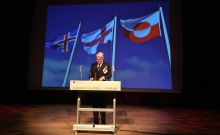
On the surface, it was perhaps out of character, then, that the organisation selected Ólafur Ragnar Grímsson to be the inaugural recipient of an award established to honour an individual who has worked in the interests of the council.
Mr Grímsson, the Icelandic president, is probably best known for being a tireless proponent of an Arctic development that includes countries as far flung as Singapore and Korea.
Many, however, will recall that the first edition of the Arctic Circle, an annual conference founded by Mr Grímsson and held in Reykjavik, featured the premiers of both the Faroe Islands and Greenland in prominent roles.
Such examples, according to the council, are not unique for Mr Grímsson’s work when promoting the Arctic. And it was this willingness to place all three countries at the centre of discussions that have come to be the domain of global powers, the council decided, that made him worth recognising.
SEE RELATED: Editor’s Briefing | The Arctic-thingi
Mr Grímsson is a big proponent of Arctic development globally, but he has done so while also seeking to promote the three western Nordic countries as a distinct part of the region.
In accepting the award, he reiterated his advice to the three countries to prepare for the heightened interest in their territory and their resources.
“This is a milestone that we – the Faroese, Greenlanders and Icelanders – must bear the burden of, but which we can also reap the rewards of,” Mr Grímsson said.
He added that taking advantage of the benefits of the increased global importance of what he calls “the New North” required a common regional strategy in areas like shipping, fisheries and underground resources.
Dealing with the pressures exerted by major political and economic powers, according to Mr Grímsson, was possible, but it required the three countries to band together to understand the forces that were being exerted on them.
SEE RELATED: Arctic assembly: Iceland prepares for historic summit
Such a process, according to Unnur Brá Konraðsdóttir, an Icelandic MP and a vice-chair of the West Nordic Council, was already underway as part of the council’s effort to identify what Arctic interests the three countries had in common.
Doing so, she said, would help national governments to co-ordinate policy. It would be a big step in taking advantage of the new direction.