Inu-it’s the economy, stupid
iAbout Press releases
As part of our continuing efforts to bring you as much information about our region as possible we offer readers a press release service that allows private firms, public agencies, non-governmental organisations and other groups to submit relevant press releases on our website.
All press releases in this section are published in their full length and have not been edited.
If you have a press release or other announcement you would like to have published, please send it to [email protected].
We reserve the right to reject press releases we deem irrelevant or inappropriate.
All material submitted to The Arctic Journal, including pictures and videos, will be assumed to be available for publication by The Arctic Journal and its related entities.
Those unaware of the importance the quadrennial Inuit Circumpolar Council’s General Assembly holds for Inuit should consider the case of Aleqa Hammond.
In November, Hammond, Greenland’s premier, invoked the wrath of the Greenlandic chapter of the ICC when her government stripped away the majority of the organisation’s public funding starting this year, and then cutting it out of the national budget entirely starting in 2018.
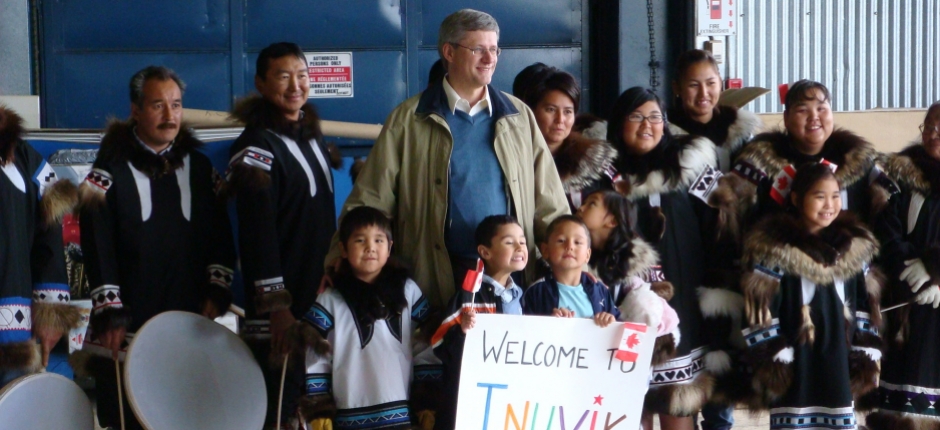
The feud has soured relations between ICC Greenland and Hammond’s government. Nevertheless, Hammond, who is Inuit, confirmed earlier this month that she would be attending the four-day meeting, which officially gets under way in Inuvik, Northwest Territories, on Monday.
Her attendance, likened to entering into the “lion’s den” by Sermitsiaq, a Greenlandic weekly and this website’s sister publication, was welcomed by observers outside Canada, who point out that it underscores the dual significance of the General Assembly for Inuit.
First and foremost is the cultural significance.
“It’s not that often that Inuit get together,” says Duane Smith, the head of the ICC’s Canadian chapter, which is hosting the meeting that will draw together 600 Inuit from Alaska, Canada, Greenland and Russia. “We’re all so spread out. The General Assembly is a celebration of Inuit culture and well-being, and it is important for people to be there. It’s satisfying to be together.”
SEE RELATED: Gonna party like it’s 1992
Second, and perhaps more importantly, is that the General Assembly and the issues it brings up will set the agenda for the work of the ICC for the next four years. And Hammond, as the elected leader of an Inuit territory, has a key role to play in that discussion.
Politics, though, will be a secondary concern during this General Assembly. In confirming her attendance, which came during the visit of Peter Taptuna, the premier of Nunavut, a Canadian territory whose population is mostly Inuit, Hammond said the pair would seek to put economic issues such as Europe’s ban on seal imports on this week’s agenda.
Despite her spat with the ICC on her home turf, Hammond’s focus on economic issues in Inuvik is unlikely to meet resistance.
Organisers have described the 2014 General Assembly, titled “One Arctic, One Future”, as “the most pivotal” since the organisation’s founding in 1980 – not least because global warming has opened up the region to economic activity.
“We face a time of change, not just for Inuit, but for the Arctic as a whole,” Smith says. “These changes pose challenges, but they also bring opportunities with them and we need to discuss how we can take advantage of them.”
SEE RELATED: Future of Arctic not as smooth as it appears
The General Assembly will focus on five topics: economic development, environment, health and well-being, hunting and food security, and governance. During the meeting delegates will adopt the Kittigaryuit Declaration to replace the Nuuk Declaration, passed in the Greenlandic capital in 2010 and which guided the work of the Greenlandic chairmanship for the past four years.
The Nuuk declaration focused on a number of social issues – including promoting circumpolar media (both traditional and social) as well as seeking to promote greater involvement of children and elders in the work of the ICC. The Kittigaryuit Declaration will strive to include issues “that all ICC members want to pursue”, Smith says, though he emphasises that Canada’s ICC chairmanship is going to prioritise development.
“We see this as a way to push governments in not just Canada, but all the Arctic countries, to work with Inuit on economic development,” he says.
SEE RELATED: ICC Greenland shocked at proposed funding cuts
One of the specific initiatives the Canadian chairmanship will put forward will be an Arctic Inuit economic conference, which Smith envisions primarily as a way to manage terrestrial and maritime species.
“These are cross-border populations, and they require a cross-border approach,” he says.
Earlier this month, the Canadian government announced its own plans to hold a founding meeting for an Arctic Economic Council that will facilitate business development in the region, and Smith suggests that the ICC’s focus on economic development will complement those efforts.
“We would like to work with the Canadian government to streamline the AEC to have focus on Inuit and to make sure that the ICC gets included as a permanent partner so that those taking part can benefit from our insights,” he says.
SEE RELATED: Unique, but similar
At the end of the assembly, Canada will officially assume the chairmanship from Greenland, when Aqqaluk Lynge, the current chair, hands over the mantle to Okalik Eegeesiak, who currently heads the Qikiqtani Inuit Association, which administers the land claims process for the Baffin region of Nunavut.
Once that happens, Canada will hold both the chairs of both the Arctic Council and the ICC, as well as having an Inuit minister for the Arctic. That situation, Smith reckons, can only benefit the ICC.
“This is a rare overlap and we need to make the most of it while we can,” he says.