Who knows best?
iAbout Press releases
As part of our continuing efforts to bring you as much information about our region as possible we offer readers a press release service that allows private firms, public agencies, non-governmental organisations and other groups to submit relevant press releases on our website.
All press releases in this section are published in their full length and have not been edited.
If you have a press release or other announcement you would like to have published, please send it to [email protected].
We reserve the right to reject press releases we deem irrelevant or inappropriate.
All material submitted to The Arctic Journal, including pictures and videos, will be assumed to be available for publication by The Arctic Journal and its related entities.
After a brief hiatus, the Week Ahead, our regular look at issues we’ll be paying attention to in the coming week, is making a return this week. As always, please contact us with suggestions for topics worth considering in the coming weeks.
After two widely covered stories in Nunavut last week, and with persistent safety concerns about this summer’s passage of the Crystal Serenity, a cruise ship with room for 1,000 passengers, through the Northwest Passage, rescue and emergency services will be a topic of discussion.
The happier of the two stories involves the rescue last week of three people after being lost for eight days. The three were reportedly able to survive because they had built an igloo once they became aware of their situation. The group also managed to shoot two reindeer, which they could use for food and to keep warm.
The second, and less fortunate, incident, involves a Cambridge Bay man who is expected to have his hands amputated after they became severely frostbitten when he got lost for six hours during a blizzard in March. Now in hospital in Edmonton, Romeo Tucci had been awaiting news of whether the damage done was reversible. It is not, and Canadian media reported last week that he will have his hands removed tomorrow.
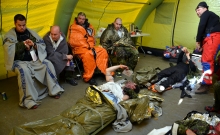
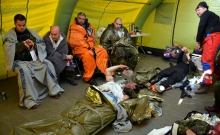
SEE RELATED: Mock shipwreck reveals holes in preparedness plans
The matter has sparked a discussion about what standard procedure for treating severe frostbite (which, in Mr Tucci’s case was comparable to third degree burns) should be. Mr Tucci was treated at the local health facility and sent home for three weeks before being transferred to Edmonton. Local health officials said that given the relatively simple procedure for treating frostbite (thawing the frozen body part and preventing infection) while waiting to assess the damage, it is unlikely that a larger hospital could have done anything different.
“The treatment's the same whether you're in Edmonton or in Cambridge Bay,” Sandy McDonald, Nunavut’s chief medical staff, told CBC North, (warning, article contains graphic image) a broadcaster.
Speaking with Nunatsiaq News (warning: article contains graphic image), Dr McDonald acknowledged, however, that certain treatments that may have been able to prevent amputation are not available in Nunavut.
Locally, the two incidents will offer lessons for how to respond in the future, but they may also prove valuable as the region prepares for a future that will see an increasing number of travellers. Canadian and American coast guard officials, for example, are worried about the passage of the Crystal Serenity and have already begun to assess the worst-case scenarios, should an accident occur.
If asked, those involved in last week’s rescue would remind them of the importance of local knowledge. The most important thing to remember may have been the comment made by Pauloosie Keyootak, one of those rescued, to CBC North, upon arriving home safely. “You cannot win against Mother Nature.”
Politics in Greenland
In Greenland, politics, both at home and abroad, will be the order of business this week. Today, it will be foreign policy that takes centre stage as two senior diplomats from Copenhagen field questions during a public meeting that will focus on the Arctic and Greenland’s role in Danish foreign policy.
For Erik Vilstrup Lorenzen, the Arctic ambassador, the appearance begins the process of winding down his term in the position. In June, he will be replaced by Hanne Fugl Eskjær, the current ambassador to Bangladesh.
The other diplomat, Peter Taksøe Jensen, a former ambassador to the US and currently to India, has been tasked with retooling Danish foreign policy. Mr Jensen has previously made it known that the Arctic will feature largely in Danish foreign policy in the years to come, based on the assumption in Copenhagen that the region will take on increasing significance for economic and security policy.
SEE RELATED: Editor’s Briefing | Inatsisartut
The meeting in Nuuk is taking place during a reshuffle in the Greenlandic foreign service that will see Mininnguaq Kleist take over at the country’s representative office in Brussels. Lida Skifte Lennert, formerly the Brussels representative, will now head the Copenhagen office, a position that has been vacant since 2014.
On Friday, domestic politics will come to the fore, as Inatsisartut, the national assembly, opens its spring session.
Much is made of the high-political issues facing the country, and these will take up a fair share of the legislators’ time And to be sure, there are a number of noteworthy proposals to be taken up, including three separate requests to hold a referendum about uranium mining. Also of note: strengthening the use of Greenlandic in the media; whether to accept refugees; and changing the country’s official name, from Kaalallit Nunaat to Inuit Nunaat.
The majority of the proposals, however, will focus on the day-to-day business of running a country. During the 60-day session, the 31 legislators will also take up a number of nuts and bolts issues that would not be out of place on the agenda of most legislatures. These include topics such as childcare, drug testing in schools and support for entrepreneurs.
The session is due to end on June 2, when a bill on subsidies for cultural activities will have its third reading. Drama, from start to finish.