Giving a little help from above

iAbout Press releases
As part of our continuing efforts to bring you as much information about our region as possible we offer readers a press release service that allows private firms, public agencies, non-governmental organisations and other groups to submit relevant press releases on our website.
All press releases in this section are published in their full length and have not been edited.
If you have a press release or other announcement you would like to have published, please send it to [email protected].
We reserve the right to reject press releases we deem irrelevant or inappropriate.
All material submitted to The Arctic Journal, including pictures and videos, will be assumed to be available for publication by The Arctic Journal and its related entities.
Since there have been humans, they have looked up at the stars and wondered. And no organisation has done more cultivate that wonder than Nasa.
Although less glamorous than its search for the stars, America’s space agency has a mandate to study our home planet. With the launch of the project Arise, Nasa has begun a mission to further our understanding of why Arctic sea ice is disappearing.
Playing a key role in those efforts will be Walt Meier, of Nasa’s Goddard Space Flight Centre, near Washington, DC. A scientist working in the facility’s Cryospheric Sciences Laboratory, he’s more concerned with looking back down on earth than he is peering into depths of the final frontier.
“Ever since it was founded, Nasa has had a mandate to look at the earth, to look downward as well as upwards. We study all the planets, including our own,” Meier says. “This is an important part of our work, and Nasa has the researches and technology that other organisations don’t. Even though people aren’t as familiar with the work we do on earth, it is one of the most important aspects of what we do.”
SEE VIDEO: Interview with a cryrospheric scientist, a horror story
Meier started out studying aerospace engineering at the University of Michigan, but moved Atmospheric and Oceanic Science, a field he holds a PhD in from the University of Colorado, Boulder. It was during his post-graduate studies that he developed an interest in global warming and the Arctic.
“The Arctic is one of the more exotic environments on the planet, but it wasn’t really until in school that I got interested in it. I was looking for a research project, and it just so happened that the person I started working with was doing a project on the Arctic. It was in some ways an accident.”
According to Meier, there are multiple reasons why an organisation like Nasa, and the public in general, should be interested in what is happening in the Arctic. First among them: it is the canary in the coal mine.
“The most important thing we are interested in is climate change, and the Arctic is the first region wher we have changes we can see and observe,” he says. “The other thing is that it is a harbinger of things to come. It is not a separate environment per say; it is tied to the rest of the Earth, so the changes that happen there have an impact elsewhere.”
SEE RELATED: Putting ice loss on the map
Should anyone have thought so, working as a scientist is nothing like Hollywood makes it out to be; Meier spends a lot of his time on the computer or, when he’s less fortunate, dealing with red tape.
“For some scientists the lab coat is the standard, but my time is spent mostly outside of the lab, on the computer. I spend a lot of time running up research, making proposals, so the actual research you are trying to fit into your spare time, even though it is our bread and butter,” he says. “Another important aspect of our work is informing people about what we are doing, because we are also serving the public and the taxpayers that pay our salaries, so we have to be responsive to those kind of things.”
The planet, scientists agree, is warming, but there is a lot of work to be done to work out the precise mechanisms, and Meier admits that the fast changes have caught us off guard.
“The changes are greater than we thought,” he says. “People were looking at the Arctic and the sea ice as something that would obviously change, and even 12 years ago we were seeing indication, but we thought it would be gradual. But in the past 14 or 15 years we have seen extreme lows in sea ice and big changes in Greenland, far bigger than we thought could happen so quickly. We have lost over a third of the summer sea ice cover, and over half of its thickness on average.”
SEE RELATED: Arctic report card: G for green
These unprecedented changes will have a big impact on the region, and, more significantly, the people who live there.
“The changes are coming faster, and that means there isn’t enough time for mitigation and adaptation. Sea ice is particularly sensitive to these changes. When you go from minus 1 Celsius to plus 1 Celsius, that is the difference between skating on ice or swimming in the ocean. So temperature changes that might not be noticeable in other parts of the world can make a big difference up there.”
In many cases, Northern peoples have already seen their lives impacted.
“This is not something that is going to happen, it is already here,” he says. “Within two or three decades all the sea ice will melt away by the end of summer, and that will leave a very different environment. The only way to prevent that is by drastically reducing carbon emissions, but the treaties that would be necessary to do this are looking a lot further down the road.”
Meier underscores that as the scientific evidence for global warming mounts, the focus of the discussion appears to be shifting towards its human impact.
“We are still trying to understand climate systems completely, but we now also need to recognise that the climate affects human activity, especially in the North and in Aboriginal communities. So working and focusing closely on these things is a key thing for the future.”
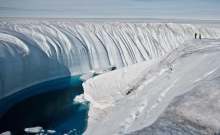
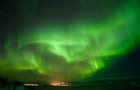
The photo at the top of this article was taken in 2005, according to Nasa.
This article is a part of our Northern Profiles series. Join us each Monday as we profile an Arctic personality, past or present.