When Dmitry Rogozin speaks, people worry

iAbout Press releases
As part of our continuing efforts to bring you as much information about our region as possible we offer readers a press release service that allows private firms, public agencies, non-governmental organisations and other groups to submit relevant press releases on our website.
All press releases in this section are published in their full length and have not been edited.
If you have a press release or other announcement you would like to have published, please send it to [email protected].
We reserve the right to reject press releases we deem irrelevant or inappropriate.
All material submitted to The Arctic Journal, including pictures and videos, will be assumed to be available for publication by The Arctic Journal and its related entities.
We arrived in Longyearbyen in Spitsbergen pic.twitter.com/C8ZUNu9qLv
— Dmitry Rogozin (@DRogozin) April 19, 2015
From Rogozin, without so much love.
All of a sudden, the Cold War seems to be flaring up along one of the world’s iciest fronts.
Svalbard is the home of extreme cold, but it appears that it also provided the backdrop for a chill in diplomatic relations last month when Dmitry Rogozin, Russia’s deputy prime minister and one of the leading architects of Moscow’s foreign policy, paid an unexpected and unwelcome visit to the Norwegian territory. Mr Rogozin landed without notice at Longyearbyen’s airport, where he transferred to an aeroplane that could take him on to his destination: a research station perched on ice floe near the North Pole.
Mr Rogozin’s transit through Svalbard raised hackles in the West for a number of reasons. Not least because he is one of the brains behind Russia’s annexation of Crimea. As a result, he’s been hit with personal sanctions that ban him from entering the EU. Norway, though not a member of the union, has signed on to the sanctions. Had Mr Rogozin sought to travel to Norway aboard a regular passenger aeroplane, he would have been turned back at the border.
SEE RELATED: Editor’s Briefing | Russian militarisation
Mr Rogozin was, without a doubt, aware of this, which is why he opted to fly aboard his own plane, and travel directly from Russia to Svalbard. Norway, already up in arms about the affair, became even more irate after Mr Rogozin began bragging about his disdain for the rules.
In Norway’s eyes, Russia is thumbing its nose at the 1925 Svalbard Treaty, which Moscow has signed, and which gives Oslo control over the archipelago.
It only served to deepen the chill when Mr Rogozin, upon reaching the Russian scientists, stated that what happened in Crimea last year could be repeated in the Arctic this year.
“Russia has begun to understand its place, its borders and its interests,” he said. “We saw something historic take place last year. Russia’s territorial integrity was restored. This year, we are casting our glance elsewhere. We are taking a closer look at the development of the Arctic. The two things are the same.”
Such statements are bound to get attention, not least when they come from a man who last year was tapped by Moscow to lead co-ordination of Russia’s Arctic affairs.
Coupled with Russia’s increasing military activity in the North, Mr Rogozin’s antics went a long way towards cementing an image of Moscow as a potential aggressor in the region.
Svalbard has, understandably, more cause for alarm than other parts of the Arctic. People there know first-hand how far Moscow, during the days of the Soviet Union, was willing to go in order to protect its interests at times when the Cold War appeared ready to turn warm.
Until 1991 and the collapse of the Soviet Union, Moscow kept an illegal arms depot in Svalbard. Should hostilities have broken out, the weapons were to be used by Soviet forces to take Longyearbyen’s airport. What’s more, the Kapp Heer helicopter station outside Barentsburg, a mining town, then, as now, under Moscow’s control, was in reality a military facility under the command of the Northern Fleet. Svalbard was also home to other Soviet military installations, including a listening post capable of monitoring American submarines.
By keeping weapons on Svalbard, Moscow was in violation of the Svalbard Treaty, even if the Norwegian authorities would have had difficulty proving it (if they could have proved it at all). Part of the challenge would have been proving that they were not intended for self-protection or hunting purposes, which the treaty does permit.
The airport in Longyearbyen opened in 1974, to Moscow’s displeasure. The facility was intended for civilian use, but Moscow saw it more for as a potential military airport that could provide Nato with an airbase in the Arctic. In the Kremlin, the fear was that Longyearbyen could be used to launch attacks on key military targets.
Moscow’s response was to send two intelligence officers to Kapp Heer. There, they worked out a strategy for capturing the airport in the event it appeared that East and West were on a collision course in the North. All of a sudden, military qualifications began playing a big role in whether someone got assigned to work at the mine in Barentsburg. The military’s plan called for the Soviets to form two groups: one that would secure the road going into the airport, closing off access to outsiders, while the other was to capture the airport itself.
Both groups were to hold on to their positions until Soviet special forces showed up. Once the operation was successful, the Northern Fleet could use Svalbard as a base for its attacks on American submarines and other convoys in the North Atlantic.
Fortunately, the strategy was never put into action, and Moscow’s intelligence gathering efforts in Svalbard came to an end with the demise of the Soviet Union. The weapons that had been stockpiled were discreetly shipped back to Russia. For the Kremlin, the biggest fear was always that one of the miners would defect and spill the beans about the top-secret plans to Norwegian officials.
Nowadays, the fear of a new military rivalry has begun to creep back into the Arctic, much of it framed in the same rhetoric that was common during the Cold War. Moscow, for example, suggested that if Copenhagen signed on to Washington’s missile defence system, it would justify the use of nuclear weapons against it. Washington, for its part, has been warned not to send troops to the Baltic countries.
Threatening other countries – whether it be a Lilliputian state like Denmark or America, the world’s strongest military power – with atomic war, uneases Russians, who are concerned that the Kremlin is being careless. Many, in fact, felt safer during the first Cold War than they do now.
This is particularly the case for the seamen sailing in the Northern Fleet. Their worry is the constant exercises are not being carried out safely. For many, the wreck of the Kursk during a military exercise in 2000 remains a warning of what can happen. They, too, would prefer a return to the cautious antagonism of the first Cold War.
SEE RELATED: The mayor who’s out in the cold?
Still others dream of an Arctic entirely free of nuclear weapons. Achieving that goal, however, may not be so simple. In the Putin doctrine, a good neighbour is a weak neighbour who is open not just to Russian influence, but also to Moscow’s domination of its near-abroad.
That is all the more reason why we should strive to maintain the balance of power in the Arctic – and why it is so unacceptable that Mr Rogozin saw fit to flout the sanctions Norway had placed on him.
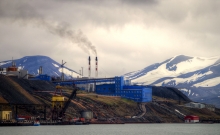
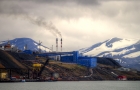
(Note: The image above has been cropped from a much larger panorama of Barentsburg and surroundings in order to suit the limitations of this website. View the full image.)
This article is published as part of our Keeping the Peace series, an on-going effort by Sermitsiaq, our sister publication, and The Arctic Journal to focus on the issue of threats to regional stability.