The Arctic in the time of sanctions
iAbout Press releases
As part of our continuing efforts to bring you as much information about our region as possible we offer readers a press release service that allows private firms, public agencies, non-governmental organisations and other groups to submit relevant press releases on our website.
All press releases in this section are published in their full length and have not been edited.
If you have a press release or other announcement you would like to have published, please send it to [email protected].
We reserve the right to reject press releases we deem irrelevant or inappropriate.
All material submitted to The Arctic Journal, including pictures and videos, will be assumed to be available for publication by The Arctic Journal and its related entities.
When Western countries began to take a hard line against Russia in early 2014, the aim was to force Vladimir Putin to change his mind about meddling in Crimea and Ukraine. Doing so also stoked a bitter debate over whether the Russian president had Arctic territory on his to-annex list.
On the one side of the discussion were those who held staunchly fast to the belief that, despite fraying relations over Ukraine, there would be no spill-over into the Arctic. Diplomatic relationships may groan, it was underscored, but the system would not break down, if only because that was what served Moscow’s interests best.
Russia, it was argued, needed the Arctic for its economic potential, primarily oil and gas extraction, but also shipping. And without the stability conferred by its adherence to diplomacy in the region, those plans would go no-where.
SEE RELATED: Be prepared for realpolitik over arktik politik
Even some who had warned against Russia’s military activity in the North suggested the concerns were overblown; Ukraine and the Arctic were apples and oranges. In the Russian mentality, Ukraine is part of Moscow’s near-abroad, and it still lies outside the Nato umbrella. Mr Putin, despite the West’s admonishments, could do as he pleased. In the Arctic, on the other hand, Moscow’s opposite numbers are all firmly in the Western camp, either as Nato members or members the EU, or both.
Others, particularly those who held elected office, repeatedly expressed worry about Russia’s growing military presence in the region. Base re-openings and exercises became emblematic of a growing regional mismatch in Moscow’s favour. The alarmists in this lot see Moscow’s recent continental-shelf claim as the prelude to a land grab, despite the evidence pointing to the opposite being the case.
Now, one year after sanctions were formally imposed, Mr Putin is looking more entrenched than ever in Crimea. Meanwhile, the situation in eastern Ukraine appears to have become a quagmire.
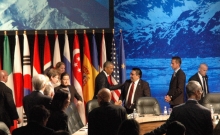
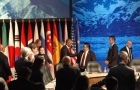
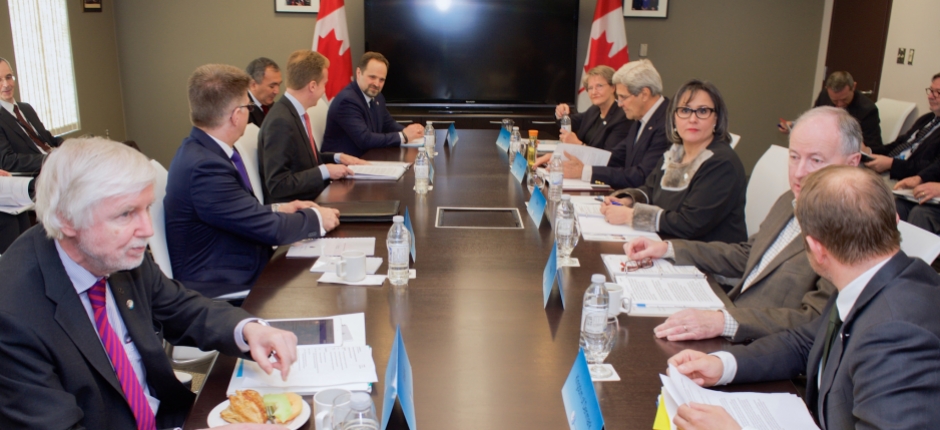
To be sure, Arctic relations are not entirely smooth either. Perhaps most glaring was the absence of Sergey Lavrov, Russia’s foreign minister, from the Arctic Council’s biennial summit in April. Officially, this was due to a busy schedule, though most also suspected it was an effort to snub Ottawa for its hard line against Moscow since the conflict over Ukraine began. Still others suggest that not showing up was the least bad option; staying away may have been an effort to ensure that bigger issues didn’t overshadow the meeting.
SEE RELATED: Canada ratcheting up rhetoric towards Russia
Robert Murray, the vice-president for research with the Frontier Centre for Public policy, is among those who reckon that the situation in Ukraine can be tied to the increase in Russian military activity and its rhetoric over the Arctic. Even so, he argues against assuming that Moscow is planning to pick a fight.
“There is a difference between tension, rivalry and overt conflict. Tensions exist,” he says, “But the fact that all states seem to be consciously insulating Arctic relations from other geopolitical spheres is worthy of mention.”
Also worth noting, but easily overlooked, according to James Collins, a retired US diplomat who served as ambassador to Moscow and now works for the Carnegie Endowment for International Peace, is that Arctic states are still doing a lot of work together. There are a number of regional issues, including navigation, the environment and search and rescue, where business, he says, continues as usual. “For the most part, sanctions haven’t impinged on co-operation.”
Some areas, particularly oil and gas exploration, which are specifically targeted by sanctions, do risk being hurt. For the time being, though, Russia’s oil industry and budget planners are probably to pre-occupied by tumbling prices to take note. “Sanctions,” says Olivier Dobbels, an analyst with Polarisk, a consultancy, “are a lot less painful when oil is cheap.”
SEE RELATED: Editor’s Briefing | Russian sanctions
More worrisome than the sanctions themselves, Mr Dobbels warns, may be thinking behind them. The fact that sanctions were adopted in the first place, he suggests, indicates that the West doesn’t understand Russian politics.
“They haven’t changed Putin’s mind about Ukraine,” he says. “And they haven’t changed people’s minds about Putin.”
If anything, he reckons, the sanctions may hurt Western interests in the long-term by pushing back political and economic reforms.
This lack of understanding might also explain why some lawmakers appear eager to bring the dispute over Ukraine into Arctic relations. This was seen in April 2014, when Canada sat out of an Arctic Council meeting in Moscow in protest over the situation in Ukraine. Some Washington lawmakers are keen to do the same, according to Ambassador Collins. Those in Washington who work with the Arctic, he says, fear what might happen if they did. “That is something they work to keep from happening.”
SEE RELATED: Rekindled relations
One thing is what Russia is currently doing. Moscow’s continental-shelf claim, submitted last week to the UN, adds a new wrinkle to the discussion, but it is one that many consider to be in line with a country that is looking to play by the rules.
“What remains to be seen,” Mr Murray says, “is just how long co-operation lasts once the political negotiations over Arctic claims begins.”