If you simplify it, they will come
iAbout Press releases
As part of our continuing efforts to bring you as much information about our region as possible we offer readers a press release service that allows private firms, public agencies, non-governmental organisations and other groups to submit relevant press releases on our website.
All press releases in this section are published in their full length and have not been edited.
If you have a press release or other announcement you would like to have published, please send it to [email protected].
We reserve the right to reject press releases we deem irrelevant or inappropriate.
All material submitted to The Arctic Journal, including pictures and videos, will be assumed to be available for publication by The Arctic Journal and its related entities.
Canada’s North could be missing out on upwards of 20,000 cruise ship passengers a year due to cumbersome permitting requirements.
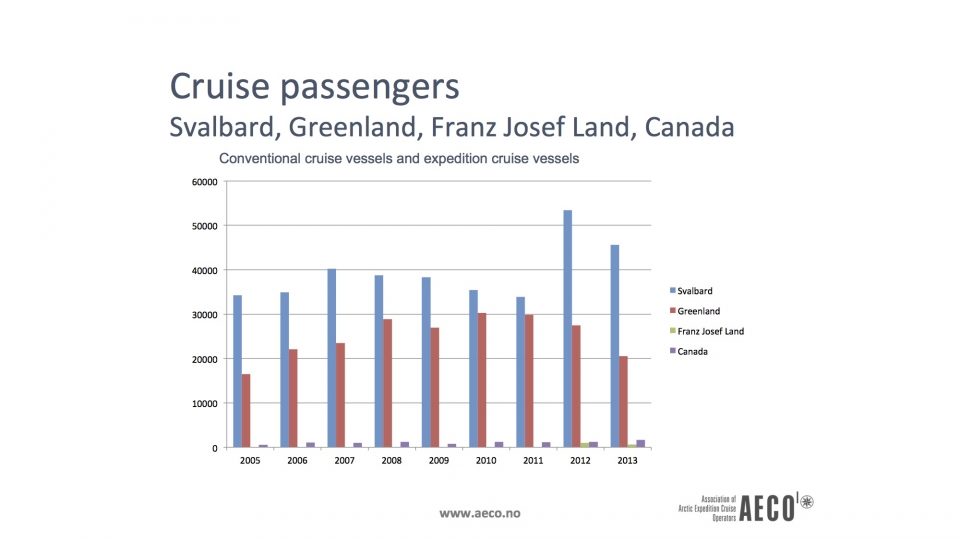
According to statistics presented by Aeco, an industry group representing Arctic tour operators, about 1,000 cruise-ship tourists have travelled to the Canadian Arctic each year since 2006. In comparison, Greenland is visited by between 20,000 and 30,000 passengers annually. Svalbard, meanwhile, is called on by over 30,000 cruise ship tourists each year (see chart below).
The situation, explains Ilja Leo Lang, an Aeco spokesperson, can be chalked up to an “out of control” permitting system that includes 50 different applications issued by 35 public authorities, at the federal, territoitorial, provincial, local and tribal levels.
“It says a lot that no-one can give us a full list of all the requirements,” Lang says. “If the authorities don’t know what permits operators need to apply for, how can operators themselves hope to?”
SEE RELATED: Statistically safer
In an open letter sent to Canadian permitting authorities last week, Aeco expressed its concern that the current regulation requirements were costing Canada tourism income.
“We strongly urge you to start a process in order to streamline the complex, time consuming, expensive and unclear permitting situation that is the reality in the Canadian Arctic,” the group, which represents 40 cruise operators, wrote.
The list of permits includes things like business licenses, firearm authorisation and permission to access First Nation or Inuit land.
Lang doubts whether all the regulations needed to apply to the tourism industry, arguing that few of them have to do with the environment or passenger saftey. Many of them were implemented before the age of global warming and the birth of the Arctic cruise industry, and often the paperwork asks whether vessels are going to be involved in activities like mining or construction. Few of them ask about tourism activities.
“The system is hopelessly out-dated. You have to get permits for all sorts of activities unrelated to tourism,” Lang says.
SEE RELATED: Cruise association expands into Russia and Canada
Irrelevant permits are one thing, the real problem, Lang and others in the industry argue, is that, unlike Greenland, which has a similar number of requirements, there is no centralised Canadian agency that operators can turn to find out which permits they need.
“Cruise operators just aren’t interested in taking on that kind of bureaucracy. Canada is seen as having a cumbersome and time-consuming application process,” Lang says.
The time it takes to keep track of all those permits adds up. For companies that sail in the North, applying for permits requires six months worth of full-time work. For firms sailing to Greenland and Svalbard, the simplified permit regulations there mean the job can be taken care of as part an administrative employee’s regular workload.
Jackie Dawson, of the University of Ottawa, was responsible for compiling the statistics about the number of passengers visiting Arctic destinations. She agrees with Aeco that the permitting process is a hindrance to the industry’s development. She cautions, however, against dropping any of the permits.
“Each and every one of them serves a purpose. It’s not the permitting that’s out of control. It is the implementation that is flawed and prevents economic opportunities.”
SEE RELATED: Mock shipwreck reveals holes in preparedness plans
Transport Canada, the federal transport ministry, has begun the process of streamlining permitting, but Dawson says, the authorities involved need to pick up the pace.
“We’re at the point right now where we have to do something, otherwise we won’t be able to compete.”
Bringing in boatloads of tourists, however, doesn’t always sit well with local populations. Up to now, the jungle of permit regulations has worked as an unintended way of keeping teh number of cruise ships down. Dawson reassures those wary of being overrun that making it easier for cruise ships to come doesn’t mean they will want to.
She also points out that a shortage of ice-strengthened ships means operators will have to consider carefully where they send expeditions.
Seen from a national perspective, making it easier for cruise ships to sail the North jibes with Ottawa’s policy of opening up the Arctic for economic development. While few believe that tourism alone is the path to a sustainable economy, even just a few more ships coming would be good news for a region where most activity focuses on natural resources.
“Tourism,” Dawson says, “could be one aspect of well-rounded economy.”