A changing frontier
iAbout Press releases
As part of our continuing efforts to bring you as much information about our region as possible we offer readers a press release service that allows private firms, public agencies, non-governmental organisations and other groups to submit relevant press releases on our website.
All press releases in this section are published in their full length and have not been edited.
If you have a press release or other announcement you would like to have published, please send it to [email protected].
We reserve the right to reject press releases we deem irrelevant or inappropriate.
All material submitted to The Arctic Journal, including pictures and videos, will be assumed to be available for publication by The Arctic Journal and its related entities.
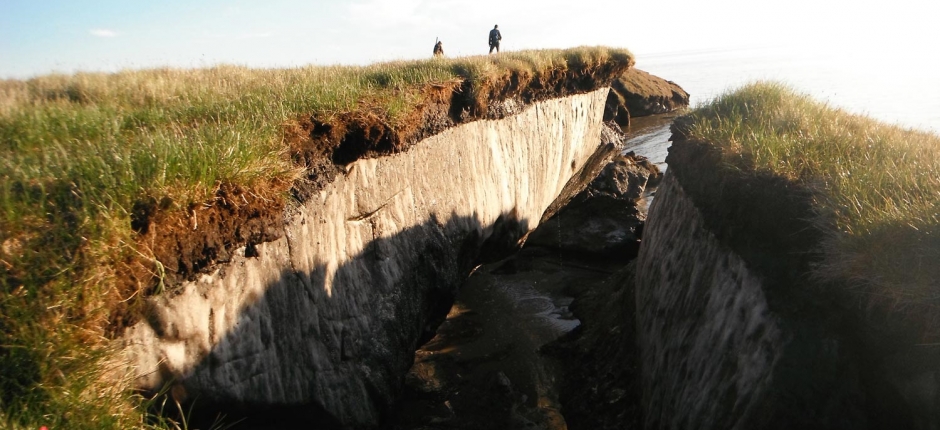
Alaska’s northern coast is undergoing dramatic changes due to erosion and the process may only be accelerating, threatening communities and infrastructure, a report, released Wednesday, concludes.
The study, part of a national assessment being carried out by the USGS, a federal agency, focused on 1,600km of Alaska shoreline between Demarcation Bay, on the US-Canadian border, and Icy Cape, where the Chukchi and Beaufort seas meet.
It found that, although there was wide variation in the 26,000 individual locations assessed in the study, and that in some areas, the coast was expanding (a process known as accretion), on average, Alaska’s Arctic coast was losing 1.4 metres annually.
SEE VIDEO: Erosion in action (at end of article)
In the most extreme cases, nearly 19 metres were being lost. In areas that were gaining coastal area, as much as 10 metres were being added annually.
Coastlines are affected by a number of natural and human factors. Predicting how the coast will change in the future, the scientists involved with the report say, can only be done by understanding how past changes had occurred.
“This report provides invaluable objective data to help native communities, scientists and land managers understand natural changes and human impacts on the Alaska coast,” says Ann Gibbs, a geologist and the report’s lead author.
The findings in Alaska and in other parts of the US are to be used in the development of a standardised method for measuring shoreline change.
SEE RELATED: Alaska no longer perma[nently] frosty
Although the assessment does not look into the causes of the changes, the Alaska study noted that longer periods without sea ice meant coastal areas were more subject to waves, storms and other factors that cause coastal change. With ice melting sooner and forming later, the report suggests that higher rates of coastal change could be expected.
The report notes in particular that the delay of ice formation until later in the autumn meant that the Arctic coast was more vulnerable to the effects of large storms that regularly occur at that time of year.
Information about coastal change is necessary for addressing changes in all coastal environments, but the situation in Alaska was “very different” from other US coastlines, the report concluded.
In addition to considering the effects of the presence of sea ice for most of the year, the study of Alaska’s coast also had less data to base its comparison on than studies of other coastal areas do. According to the USGS, other coastal studies can draw on data going back to the 1800s. The current Alaska study, by comparison, used data collected in the1940s and the 2000s.
Alaska may be America’s last frontier, but, it would appear, it is not its final frontier.
Watch more videos of Alaskan erosion.